

closed fracture


 1
4.1
1
4.1
- noun
- /kloʊzd ˈfræktʃər/
- Specialized
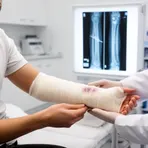
- When a fracture occurs and the bone does not come through the skin that covers the fracture site, it is considered a closed fracture.
Examples
-
- Well, I don't know what it was like when you were in medical school, but by the time I finished my second year, I could set a simple closed fracture with my hands behind my back.
-
After the accident, the X-ray showed a closed fracture of the wrist without any skin damage.
-
7. Smith sustained a "closed fracture" of his nose, a pair of black eyes, and two lacerations to
Blog text (5) -
The most common diagnosis was closed fracture with lower extremity involvement.
Academic text (2005) -
A closed fracture to the tibia is more common, whereas an open fracture is thought to be at higher risk for complications.
Academic text (2007) -
It is important to note that isolated closed fractures of the femur should not cause an acute drop in the patients' hematocrit.
Academic text (2006) -
Ulnar nerve injury rarely complicates closed fractures of the shaft of the forearm.
Academic text (2007) -
Ulnar nerve injury rarely complicates closed fracture of the shaft of the forearm, and only 7 cases, excluding the current one, have been reported in the literature so far.
Academic text (2007) -
In general, closed fractures of both the tibia and the fibula in children have fewer complications, heal faster, and have less morbidity than those in adults (Buckley, 2002).
Academic text (2006) -
A closed fracture occurs when the bone is broken but does not penetrate the skin.
Synonyms
 1
3.5
1
3.5
A broken bone that does not cut the skin or badly damage nearby tissue
Antonyms

How Severe

Surface Forms
Morphology
The meaning is directly and compositionally derived from 'closed' (not open) + 'fracture' (a break), so a B1 learner who knows both words can infer this refers to a bone break that does not penetrate the skin. The adjective+noun pattern is transparent and cross-linguistically common in medical descriptions, making the term immediately comprehensible from its parts.
Etymology
The noun closed fracture names a fracture, a break in a bone, where the skin stays closed. Imagine a broken stick inside a tight sleeve: the stick is snapped but the sleeve is not torn, so the term means 'a broken bone that does not break the skin'.