
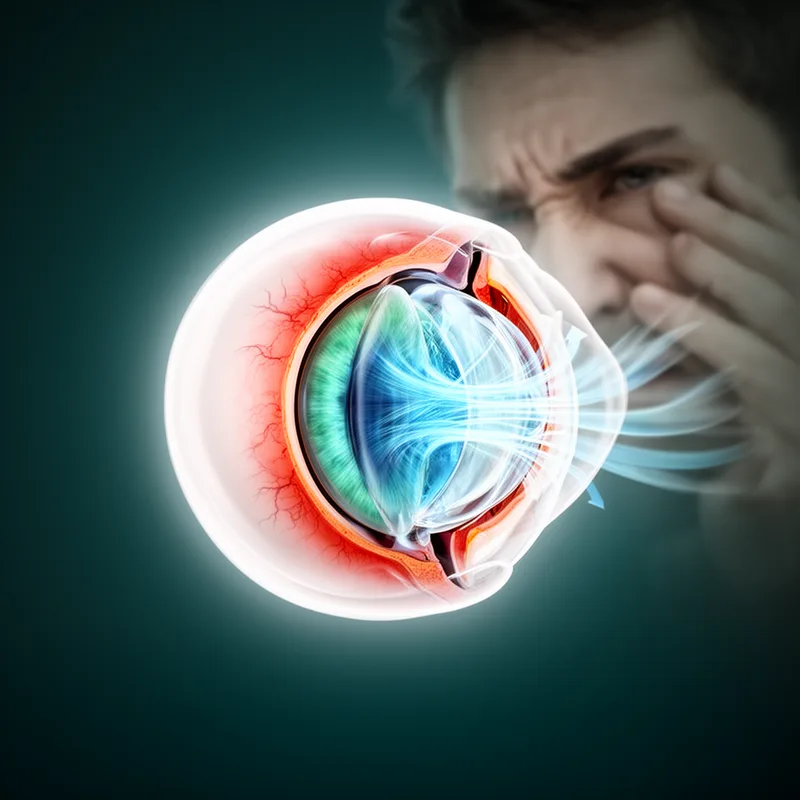
closed-angle glaucoma
- noun
- /kloʊzd ˈæŋɡəl ɡloʊˈkoʊmə/
- Specialized
- Symptoms of closed-angle glaucoma can develop suddenly and include severe eye pain and blurred vision.
Examples
-
Patients with closed-angle glaucoma usually require urgent medical attention to prevent permanent vision loss.
-
If untreated, closed-angle glaucoma may lead to irreversible blindness in the affected eye.
-
She was diagnosed with closed-angle glaucoma last year.
-
Many patients with closed-angle glaucoma experience severe headaches.
-
Patients with closed-angle glaucoma usually require urgent medical attention to prevent permanent vision loss.
-
If untreated, closed-angle glaucoma may lead to irreversible blindness in the affected eye.
-
Symptoms of closed-angle glaucoma can develop suddenly and include severe eye pain and blurred vision.
Synonyms

A sudden eye condition when the coloured part blocks fluid drainage, causing a rapid rise in pressure inside the eye

A sudden, serious eye problem when fluid inside the eye builds up, causing severe pain and risk of losing sight
Antonyms

- Specialized


 1
5.2
1
5.2
A common eye disease that slowly reduces side vision when eye fluid cannot drain
Surface Forms
Morphology
closed-angle + glaucoma
The compound is compositionally transparent: 'closed-angle' modifies 'glaucoma', so a learner who knows 'closed', 'angle' and 'glaucoma' can infer it refers to a form of glaucoma in which an angle is closed. Although the precise anatomical mechanism is technical, the core sense ('a glaucoma caused by a closed angle') follows regular modifier+noun patterns and is broadly inferable at B1.
Etymology
Closed-angle glaucoma describes a simple picture: the front of the eye becomes very narrow so the iris presses on the eye's drainage angle, 'closing' it. That closed drain makes fluid build up and the eye pressure rise quickly, which is why the condition can cause sudden pain and vision loss.