

to clock up


 1
6.6
1
6.6
- phrasal verb
- After working at the company for a year, she had clocked up over 1,000 hours of experience.
Examples
-
It has clocked up just 86 miles in its lifetime; and now it's set to go on sale for the first time since the early 1980s.
Blog text (26) -
Frank has clocked up a round trip of 150 miles in four days.
-
If a post about biking just gets every reader to clock up an extra 5 miles on their bike that week, then job done.
Blog text (2) -
I suspect that many novelists clock up sixty thousand words after a year's work and believe (wearily, perhaps) that they are only halfway there.
Blog text (4) -
Worse still, the contraction in manufacturing accelerated, and sharply so, clocking up its fifth consecutive month of contraction according to the flash estimate.
Blog text (3) -
Yet despite EVs clocking up significant speed, range, and endurance records this year, one major automaker has announced that it's pulling back on EV production to concentrate on its expanding family of hybrid vehicles.
Blog text (1) -
During her morning jog, she managed to clock up five miles before the sun rose.
-
As a taxi driver, he can easily clock up several hundred miles in just one day.
Synonyms
 54
3.6
54
3.6
To collect many points or wins
 27
6.6
27
6.6
To slowly increase over time, for example money or benefits
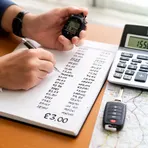
To write down and add up time or distance in a record
How Much
- Informal
54
3.6
 66
4.8
1
6.6
174
3.4
499
1.1
66
4.8
1
6.6
174
3.4
499
1.1
Surface Forms
Morphology
The sense arises from combining 'clock' (to record/measure) with 'up' (to increase/bring to a total), so a learner who knows both words can plausibly infer a meaning related to recording or accumulating a total. However, the specific collocational use 'clock up X' as a conventionalized phrasal verb meaning 'achieve/accumulate' is somewhat lexicalized and metaphorical, so it is not fully predictable without exposure.
Etymology
The phrasal verb clock up comes from the image of a machine, like a clock or meter, that counts and adds numbers as time or miles go up. So, to clock up something means 'to reach or collect a total amount'.