
civil disobedience
 29
5.6
29
5.6

- noun
- /ˈsɪvəl ˌdɪsəˈbiːdiəns/
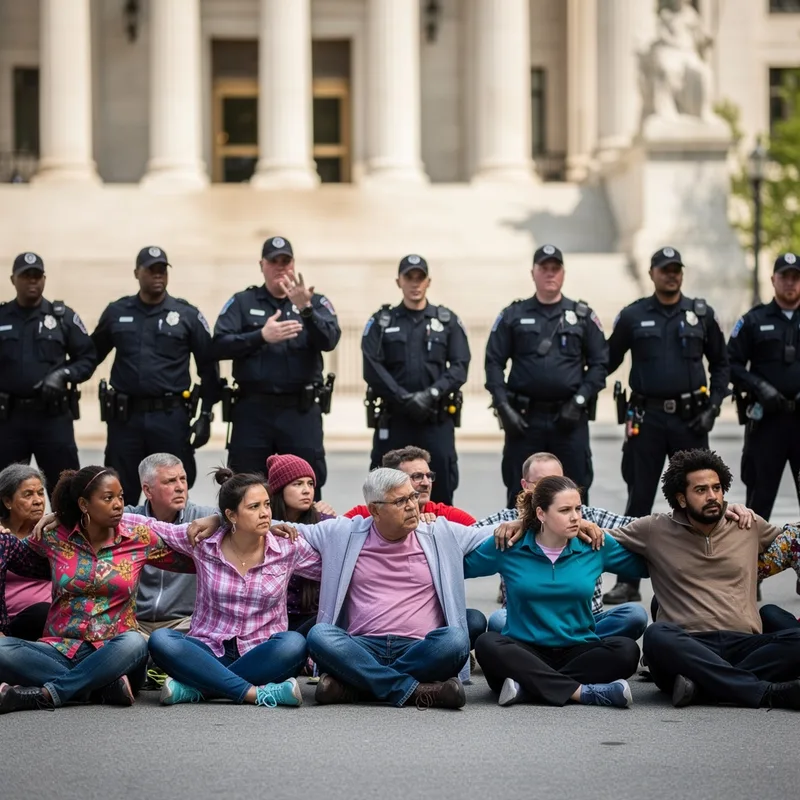
- During the protest, participants practiced civil disobedience by peacefully refusing to leave the street.
- acts of civil disobedience
- nonviolent civil disobedience
- engage in civil disobedience
Loading YouTube…
Watch on YouTubeOn several occasions, Gandhi believed in nonviolent civil disobedience.
- On several occasions, Gandhi believed in nonviolent civil disobedience.
- That the highest form of civil disobedience is to reject an unlawful order, and you may be asked to do so.
- This is organize civil disobedience and you are either participating in it or you're not.
- Aaron Schwartz, why was he a special human being in this ilk of what we're talking about now, civil disobedience?
Examples
-
Many protesters had trained in civil disobedience, expecting, some even hoping, they would be arrested.
-
Rosa Parks's act of civil disobedience merits recognition as an example of a contemporary prophetic act.
Academic text (2004) -
Consider it an act of civil disobedience.
-
I'm a part of a tradition of civil disobedience.
-
This is part of a pattern of civil disobedience across the world that follows each new natural disaster.
-
Repeated and sustained acts of civil disobedience are the only weapons that remain to us.
Blog text (5) -
Tensions are high in East Berlin tonight, as civil disobedience continues to build momentum.
-
But we also committed acts of nonviolent civil disobedience to bring attention to our cause.
Academic text (2009) -
Support for civil disobedience and confrontational political tactics was on the low end of the scale.
Academic text (2000) -
A number of deep ecologists engage in civil disobedience to protect the biological integrity of the Earth.
Academic text (1994)
Synonyms
 55
4.2
55
4.2
Refusing to obey rules or people in charge
 12
2.8
12
2.8
A public meeting where people gather to show support or opposition without violence
 7
7.7
7
7.7
Failure to follow a rule, order, or request
 2
3.9
2
3.9
A way of opposing a government without using violence, for example by refusing to obey laws
Antonyms


How Disruptive
150
5.1

- Jargon
10
5.5
29
5.6
12
2.8
- Formal
216
4.1
Surface Forms
Morphology
The meaning follows directly from combining 'civil' (relating to citizens, public affairs, or law) with 'disobedience' (refusal to obey): a learner who knows both words can infer refusal to obey laws or authorities in a civic/political context. This is a compositional, cross‑linguistically common concept rather than an idiomatic shift, so it is immediately comprehensible to B1 learners who know the constituents.
Etymology
Civil disobedience comes from Henry David Thoreau and later Gandhi, who used calm, public refusal to follow unfair laws to show they were wrong. The picture is simple: ordinary people (the civil) choose disobedience to a law in a peaceful way, so the phrase means 'refusing to obey laws as a peaceful protest'.