
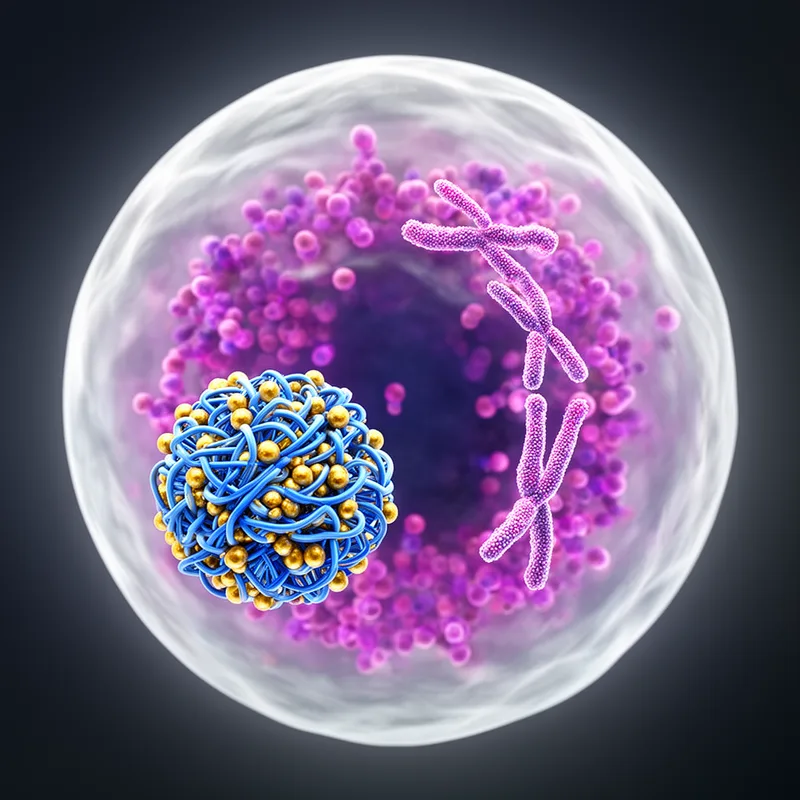
chromatin granule
- noun
- /ˈkroʊməˌtɪn ˈɡræn.juːl/
- Specialized
 :
gránulo de cromatina
:
gránulo de cromatina
- During mitosis, each chromatin granule condenses to help form chromosomes.
Examples
-
The scientist stained the sample to observe the chromatin granule structures more clearly.
-
Under the microscope, a chromatin granule is visible within the nucleus of the cell.
-
The chromatin granule plays a crucial role in gene expression.
-
Under the microscope, we observed several chromatin granules in the nucleus.
-
During mitosis, each chromatin granule condenses to help form chromosomes.
-
The scientist stained the sample to observe the chromatin granule structures more clearly.
-
Under the microscope, a chromatin granule is visible within the nucleus of the cell.
How Condensed


Surface Forms
Morphology
The noun is straightforwardly compositional: 'chromatin' (nuclear material that forms chromosomes) plus 'granule' (a small particle) yields 'a small particle of chromatin', which matches the given definition. Although the term is domain-specific/technical, its meaning is predictable from the constituents, so a learner who knows both words can infer the MWE's sense.
Etymology
Chromatin granule comes from early scientists who stained cells and saw tiny, coloured grains inside the nucleus. So chromatin means the 'stainable' material and granule means a 'small grain', which is why the term now refers to those tiny parts that condense into chromosomes.