
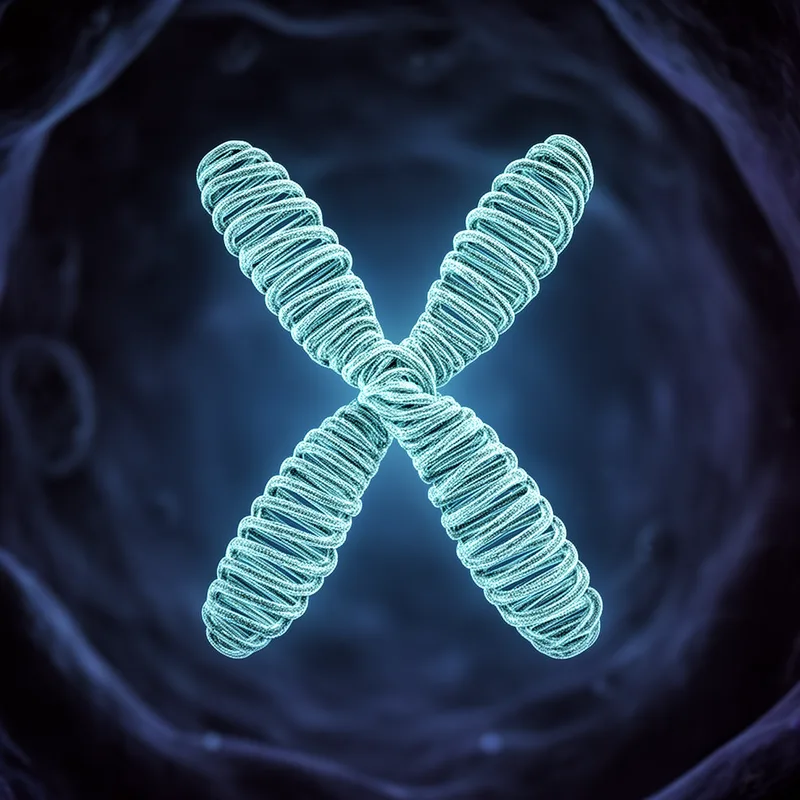
chromosome
 66
5.0
66
5.0

- noun
- /ˈkroʊməˌsoʊm/
- Specialized
- In humans, each cell typically contains 23 pairs of chromosomes that carry genetic information.
- genes on a chromosome
- X chromosome
- Y chromosome
Loading YouTube…
Watch on YouTubeWhat if the cell is a library and every chromosome is a book?
- What if the cell is a library and every chromosome is a book?
- OK, so if, if you know you've got XY chromosomes, then you really shouldn't be there.
- These tests look for uncommon chromosome rearrangements.
- Do we share the same change of DNA on our second chromosome?
- There is a, a gene called the complement factor H on chromosome one.
- Same thing with the chromosomes. After this happened,
- They're all illustrious proof armor chromosome that just we don't have.
Examples
-
Well, all men have a copy of their father's Y chromosome, but this is more than that.
-
The X chromosome was the second longest telocentric chromosome, while the Y chromosome was the shortest and only metacentric chromosome.
Academic text (2013) -
What if the cell is a library and every chromosome is a book?
-
As with the genes on a chromosome, what matters is where as well as when.
Academic text (1995) -
Does an XX chromosome make you a female or not?
-
Now you all know that there are two chromosomes of each type, right?
-
There are two types of chromosomes in most organisms.
-
A genome describes one set of an individual's chromosomes with the genes they contain.
Academic text (1994) -
Medically speaking, we would say that from the chromosomes, every potential of anybody here in this room is present at the moment of conception.
-
Many of the Hox genes have been located, ordered by position on chromosomes, and at least partly sequenced.
Academic text (1992)
Compounds


- Specialized
2
3.9
A cell part that carries genes, present once in males and twice in females and affecting traits related to sex



- Specialized
A chromosome with no centromere that cannot attach to the spindle during cell division
- Specialized
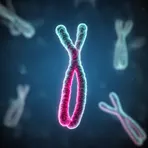
A chromosome with its centromere near one end, giving one very short arm and one long arm

- Specialized
A chromosome with its middle part near the center so the two arms are almost the same length

- Specialized
A chromosome with its joining point at the very end that looks like a straight rod
- Specialized
A part of a body cell that carries genes and usually comes in pairs, not the ones that decide sex
How Condensed
- Specialized
66
5.0

- Specialized
- Specialized
5
8.9
- Specialized
Surface Forms
Morphology
chromosome = chromo- + -some (opaque) = chromo + some
Although analyzable into Greek combining forms meaning 'colour' + 'body', the modern scientific sense 'threadlike DNA structure carrying genes' is not derivable by an average B1 learner from those parts.
Etymology
The word chromosome comes from Greek parts chroma ('color') and soma ('body'); the chroma part is the same idea as in chrome because early scientists saw these threads take up color dyes and look like tiny colored bodies under a microscope. So a chromosome is literally a 'colored body' - the threadlike part in the cell nucleus that carries genes.