
chromatid


 1
8.6
- noun
- /ˈkroʊməˌtɪd/
- Specialized
- The spindle assembly checkpoint (SAC) operates to assure proper distribution of sister chromatids.
- sister chromatids
Examples
-
Bottom: Separation of sister chromatids and movement to opposite spindle poles (anaphase A).
Academic text (2009) -
But but your sister chromatids still have to stay attached.
-
The two sister kinetochores have back-to-back orientation and are attached to the outer aspect of the chromatid.
Academic text (2009) -
But you noticed I've drawn these duplicated chromosomes with the with chromatids overlapping that.
-
Cohesin is a protein that binds sister chromatids together, and its degradation allows the sisters to be pulled apart in anaphase.
Academic text (2009) -
Moreover, because changes in DNA methylation are transmitted from mother to daughter chromatids during mitosis, epigenetic changes in response to environmental factors may be long-lasting and mediate phenotypic outcomes later in life.
Blog text (7) -
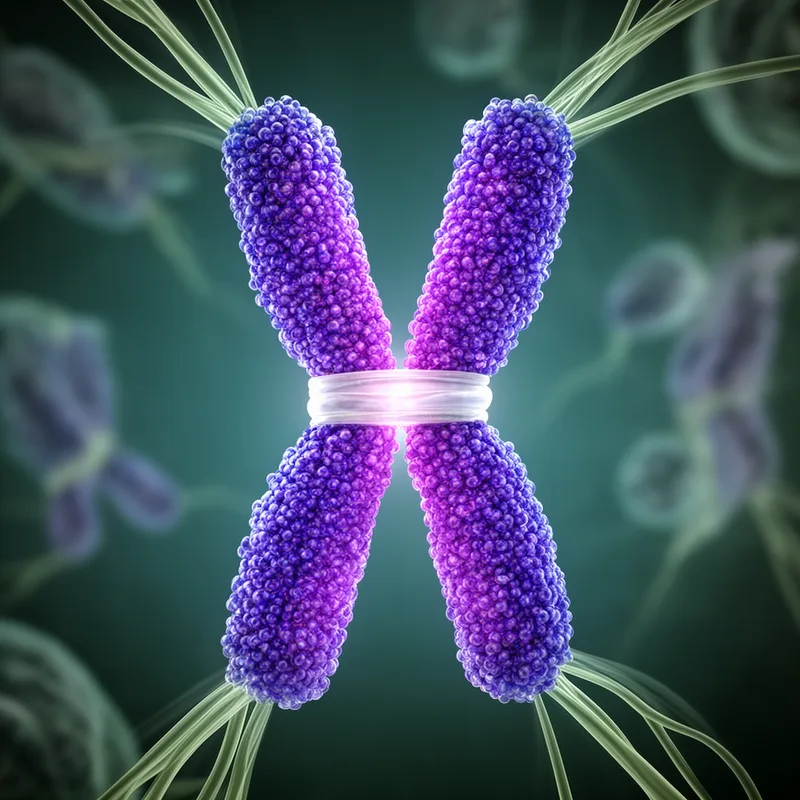
During cell division, each chromosome is made up of two identical chromatids that are joined by a centromere.
-
The sister chromatids separate and are pulled towards opposite poles of the cell during anaphase.
-
In a typical human cell, each chromosome consists of two chromatids after DNA replication has occurred.
Surface Forms
Morphology
chromatid = chromosome (opaque) = chromat + id
Although related to 'chromosome', the formation uses the scientific combining form 'chromat-' plus '-id' and the specific technical sense is not predictable for general learners.
Etymology
Chromatid comes from the Greek root chroma meaning 'colour' and the ending -id meaning 'part'. The same root is in chromosome because these pieces looked coloured under early microscopes, and a chromatid is one of the two matching 'parts' of a chromosome.