
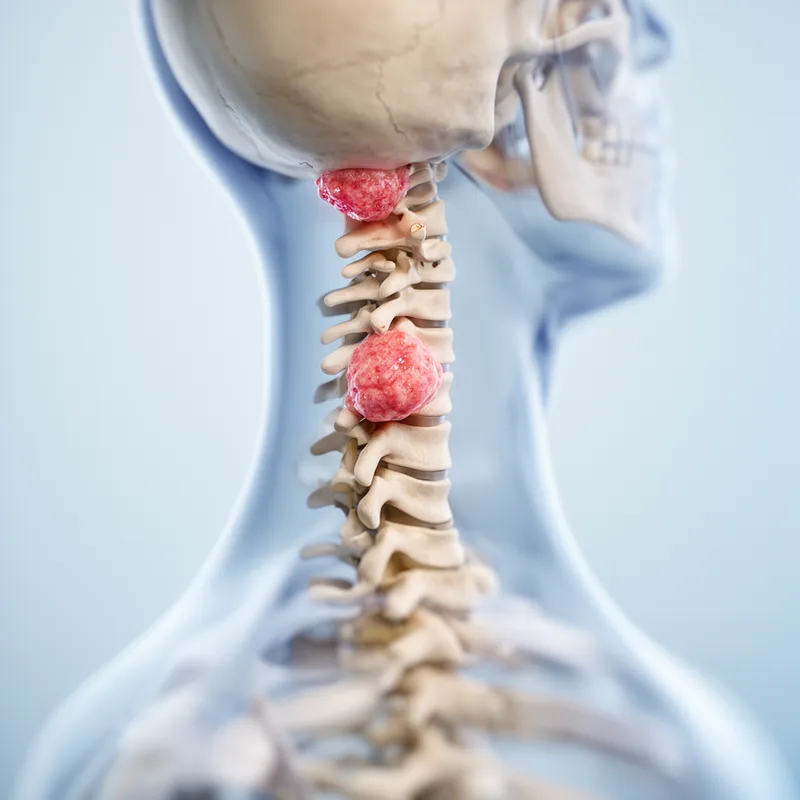
chordoma
 1
9.9

- noun
- /kɔrˈdoʊmə/
- Specialized
- Pathology of the mass revealed numerous atypical cells indicative of chordoma; the Ki-67 labeling index was 10 to 12%.
- clival chordoma
- primary chordoma
- skull base chordoma
Examples
-
Because chordoma is a rare tumor, many physicians may not be familiar with its symptoms.
-
The doctor explained that a chordoma is a rare type of cancer that can grow in the bones of the spine.
-
The presenting signs and symptoms of chordoma are related to the site of origin and the area of extension.
Academic text (2005) -
We report a case of a primary chordoma of the lateral nasal wall.
Academic text (2005) -
Histopathology identified a chordoma within the surrounding soft tissue (Figure 3).
Academic text (2008) -
All 15 lymph nodes that were removed were negative for metastatic chordoma.
Academic text (2008) -
Shugar et al. presented a case of a primary chordoma of the maxillary sinus.
Academic text (2005) -
Loughran et al. presented a case of a primary chordoma of the ethmoid sinus.
Academic text (2005) -
An estimated 50% of chordomas are sacrococcygeal, and 35% are spheno-occipital.
Academic text (2005) -
Pathology revealed no lymphoid tissue in the main specimen and no evidence of chordoma in any of the lymph nodes.
Academic text (2008)
How Serious
- Specialized
6
8.0
 ∞
2.7
- Specialized
1
9.9
- Specialized
360
3.6
- Specialized
3
3.4
Surface Forms
Morphology
chordoma = chord (opaque) = chord + oma
Though analyzable as 'chord' + '-oma', the term is a specialist medical name for a tumor from notochordal tissue and is not predictable by general learners from the common sense of 'chord'.
Etymology
Chordoma comes from a root meaning 'string' inside the body: chord means 'string' or 'cord', just like the common word cord, and the ending -oma means 'tumor'. So a chordoma is a tumor that grows from that 'cord' along the spine or base of the skull.