
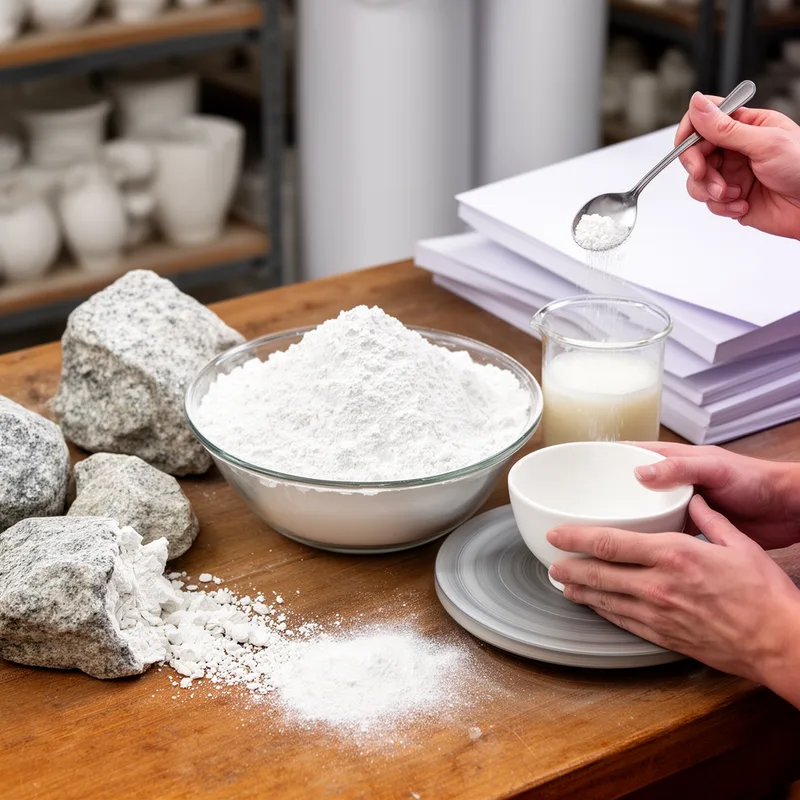
china stone
- noun
- Specialized
- The porcelain artist selected a high-quality china stone for her latest pottery designs.
Examples
-
The factory imports china stone in bulk for use in its ceramic products.
-
Paper manufacturers sometimes add china stone as a filler to improve texture and appearance.
-
The artist prefers using china stone for her pottery.
-
Many ceramics are made from china stones.
-
Paper manufacturers sometimes add china stone as a filler to improve texture and appearance.
-
The factory imports china stone in bulk for use in its ceramic products.
-
The porcelain artist selected a high-quality china stone for her latest pottery designs.
Synonyms

 171
1.0
171
1.0

A heavy sticky earth that is soft when wet and used to make pots and bricks
 1
9.0
1
9.0
A fine white clay used to make pottery and paper

A fine white clay that people use to make ceramics and paper and to absorb liquids

Fine white clay used to make porcelain and other ceramics

A fine white powder from the ground used for pottery and paper

Soft natural clay used to make pots like bowls and vases before heating
Surface Forms
Morphology
The compound transparently signals a material related to 'china' (porcelain) and 'stone' (a mineral), so a learner who knows both words will likely infer it is a mineral or material used in making porcelain. However, the precise technical sense — that it is a fine white clay formed by weathering (not literally a typical 'stone') — is specialized and not fully predictable without exposure, so it is only partially transparent.
Etymology
China stone likely comes from the use of china ('porcelain') and stone (a soft white rock or clay) that potters mixed to make smooth, strong dishes, so it now means a white clay or filler used in pottery.