
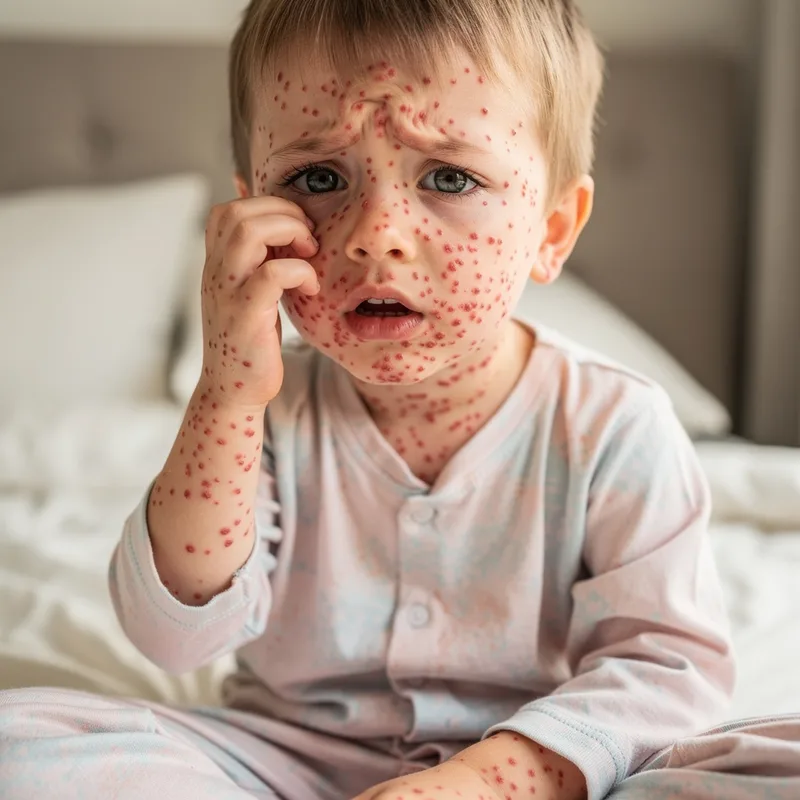
chicken pox
 21
2.0
21
2.0

- noun
- /ˈtʃɪkɪn pɑks/
- She's only got the chicken pox.
- get chicken pox
- kids with chicken pox
- chicken pox vaccine
Loading YouTube…
Watch on YouTubeAnd so we got documented things like he told his grandmother that she was going to get chicken pox and then a couple of weeks later she broke out in shingles.
- And so we got documented things like he told his grandmother that she was going to get chicken pox and then a couple of weeks later she broke out in shingles.
- Viral infections include any time you'd have the common cold, the flu, chicken pox, ear infections, measles and COVID.
- Keith had chicken pox the worst and he has like scars from it from scratching.
Examples
-
Nina got the chicken pox first, quickly followed by Ella.
-
I was seven and home sick with chicken pox the first time
Blog text (34) -
And he already had the chicken pox when he was a kid.
-
Look at this, chicken pox marks are still there.
-
Anyway, Philip Parker has chicken pox.
-
Mikey was four when they all had chicken pox at the same time.
Fiction book (1994) -
Alex's mom wouldn't let them in the house because his brother Max had chicken pox.
Fiction book (1996) -
Vaccinations have reduced the incidence of chicken pox, but the disease has not vanished altogether.
Blog text (16) -
She said he had pockmarks on his chest from a bad case of chicken pox... ...and a bar-code tattoo on the back of his neck.
-
I was six when I had chicken pox.
Synonyms
 50
7.9
50
7.9
A disease that causes skin blisters, like smallpox or chickenpox
 18
2.3
18
2.3
A disease that causes an itchy red rash and blisters often in children
 1
7.4
1
7.4
An illness that causes fever, an itchy rash, and spreads easily, often called chickenpox
How Serious

Surface Forms
Morphology
chicken + pox
The element 'pox' clearly signals a disease with blisters, so a B1 learner who knows 'pox' would infer this is a kind of skin illness; however, 'chicken' does not transparently explain why (it does not indicate the causal agent or the age-group affected) and can even mislead learners to think it involves chickens. Cross-linguistically the compound is not consistently compositional, so the overall meaning is only partly predictable from the parts.
Etymology
Chicken pox got its name because people thought this illness was much less serious than 'smallpox', so they used chicken to show it was weaker. That's why the name now means the itchy sickness with red spots and blisters.