
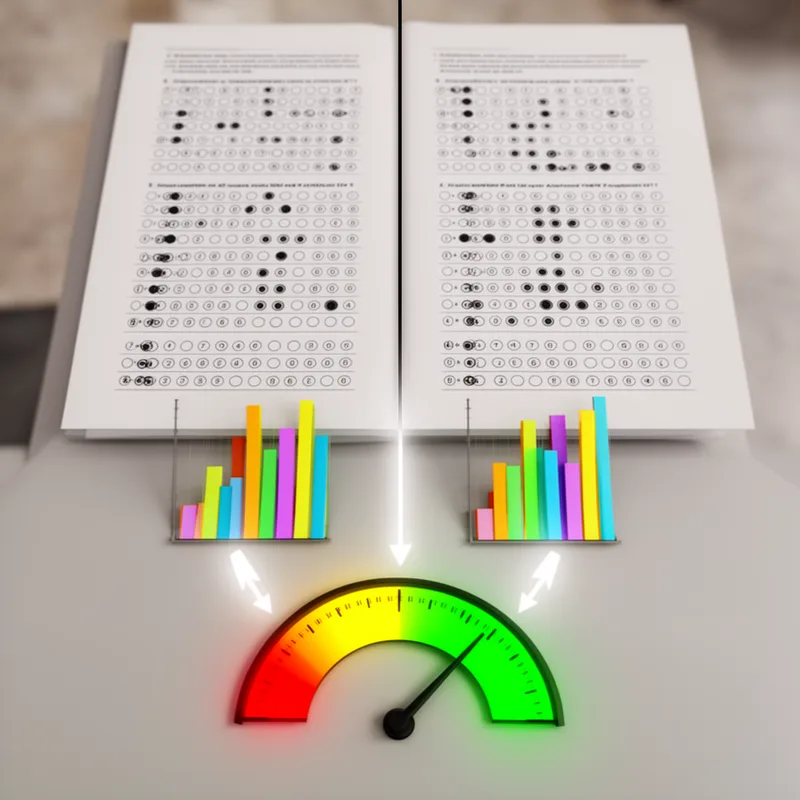
chance-half correlation
- noun
- Specialized
- The psychologist calculated the chance-half correlation to estimate the consistency of the test results.
Examples
-
A high chance-half correlation indicates the test has good internal reliability.
-
Researchers often use chance-half correlation to validate new assessment tools.
-
The chance-half correlation indicates the reliability of the test.
-
Calculating the chance-half correlation is essential for test evaluation.
-
A high chance-half correlation indicates the test has good internal reliability.
-
Researchers often use chance-half correlation to validate new assessment tools.
-
The psychologist calculated the chance-half correlation to estimate the consistency of the test results.
Synonyms

A number that shows how similar scores are on two parts of a test
Surface Forms
Morphology
chance-half + correlation
The parts 'chance' (random), 'half' (a part) and 'correlation' (a statistical relationship) do allow a reader to infer this refers to a correlation between randomly formed halves of a test. However, 'chance-half' is a specialized, hyphenated technical coinage and the precise statistical meaning and usage would not be fully predictable to a B1 learner without subject knowledge, so the transparency is partial.
Etymology
Chance-half correlation comes from a simple test trick: you split a test by chance into two halves and measure how similar students' scores are. If the two halves give similar scores, the correlation is high, so the test shows good 'reliability'.

