

ceratopsian


 1
9.9
1
9.9
- noun
- /ˌsɛrəˈtɒpsiən/
- Specialized
 :
ceratopsiano
:
ceratopsiano
- The ceratopsian dinosaurs, known for their protective frills and horns, roamed the Earth during the late Cretaceous period.
- ceratopsian dinosaurs
- ceratopsian family
Examples
-
Then it is on, on to spy on something with a long neck and a comic knobby head, and then to watch a pair of angry ceratopsians butting heads in slow motion, and then to applaud the elegant migration of a herd of towering duckbills across the horizon.
Fiction book (1991) -
Ceratopsians with new horn configurations, carnivores with spectacular head crests, and feathers done properly as insulation covering, not just a few head spines.
Blog text (21) -
Sauropods seem to be the most common kind of neo dinosaur Cryptid, but ceratopsians, iguandants and cerropods also show up in reported sightings.
-
The analysis of such characters (semophylesis after Potapova, 2013) in each vertebra of studied ceratopsians promotes the establishment of the number of morphotypes and their relationships.
Academic text (2018) -
Scientists discovered fossils of a ceratopsian that displayed intricate horn structures, indicating its adaptability to its environment.
-
Many ceratopsians, like Triceratops, had large beaked skulls that helped them feed on tough vegetation.
Synonyms

A group of plant-eating dinosaurs with large bony frills and horns on their faces, like Triceratops
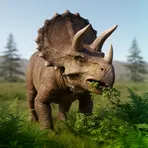
A four-legged plant-eating dinosaur with a beak, horns, and a frill like Triceratops

Large plant-eating dinosaurs with horns and bony frills, like Triceratops

A group of horned plant-eating dinosaurs like Triceratops from ancient North America
Surface Forms
Morphology
ceratopsian = Ceratopsia (opaque) = ceratops + ian
Formed by a scientific taxon name plus the suffix '-ian'; the root is a Greek combining form not a familiar English base, so the meaning is not guessable to average learners.
Etymology
Ceratopsian comes from Greek roots keras 'horn' and ops 'face'. So, a ceratopsian is a 'horned face' dinosaur, like the familiar triceratops, with a beak, horns and a frill.