
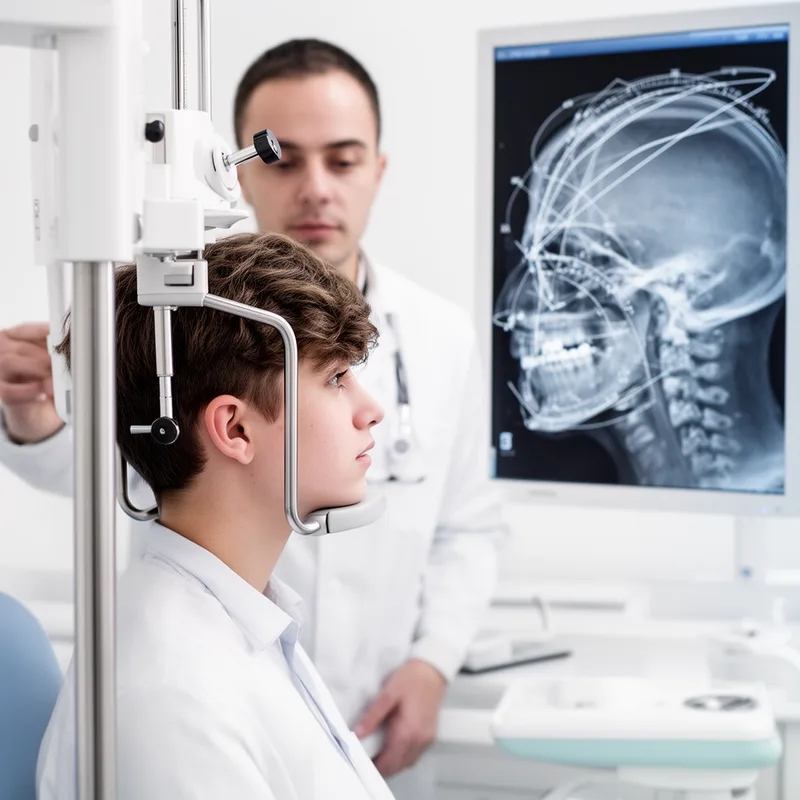
cephalometric
- adjective
- /ˌsɛfəloʊˈmɛtrɪk/
- Specialized
 :
cefalométrico
:
cefalométrico
- In orthodontics, cephalometric analysis helps doctors determine the optimal treatment plan for patients.
- cephalometric radiography
- cephalometric radiograph
- lateral cephalometric
Examples
-
A lateral cephalometric radiograph is also used to assist in treatment planning.
Academic text (1999) -
The cephalometric radiograph will document skeletal deformities and soft tissue airway narrowing.
Academic text (1999) -
The advantage of cephalometric x-rays is that they are objective methods of evaluation.
Academic text (1999) -
Normal cephalometric values are important predictors, based on values outside of two standard deviations from the mean.
Academic text (1999) -
Cephalometric x-rays
Academic text (1999) -
Three have been widely used for clinical examination: the physical examination, fiberoptic endoscopy, and cephalometric radiography.
Academic text (1999) -
Severe nasal obstruction in patients with mild OSA combined with normal cephalometric X-rays can predict a good response to nasal surgery.
Academic text (1999) -
Although cephalometric radiography is only a static two-dimensional method of evaluating a dynamic three-dimensional area, it does provide useful information on the posterior airway space.
Academic text (1999) -
Preoperative radiographic analysis, including a lateral cephalometric radiograph and a panoramic dental x-ray, is necessary to assist the surgeon in surgical planning.
Academic text (1999) -
The dentist used a cephalometric x-ray to assess the alignment of the patient's jaw.
Synonyms
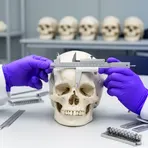
Used for measuring the size and shape of skulls

About measuring skull shape and size to study people or animals
Surface Forms
Morphology
cephalometric = cephalometry (opaque) = cephal + metry + ic
The adjective is formed from a specialised technical noun ('cephalometry'); the combining forms ('cephal-','-metry') are not productive or familiar to an average B1 learner, so the meaning is not directly derivable without domain knowledge.
Etymology
The word cephalometric comes from Greek parts cephal- meaning 'head' and -metric meaning 'measure'. So, cephalometric means 'measuring the head', which is why doctors and dentists use cephalometric tests and X-rays to study head and jaw size and position.

