
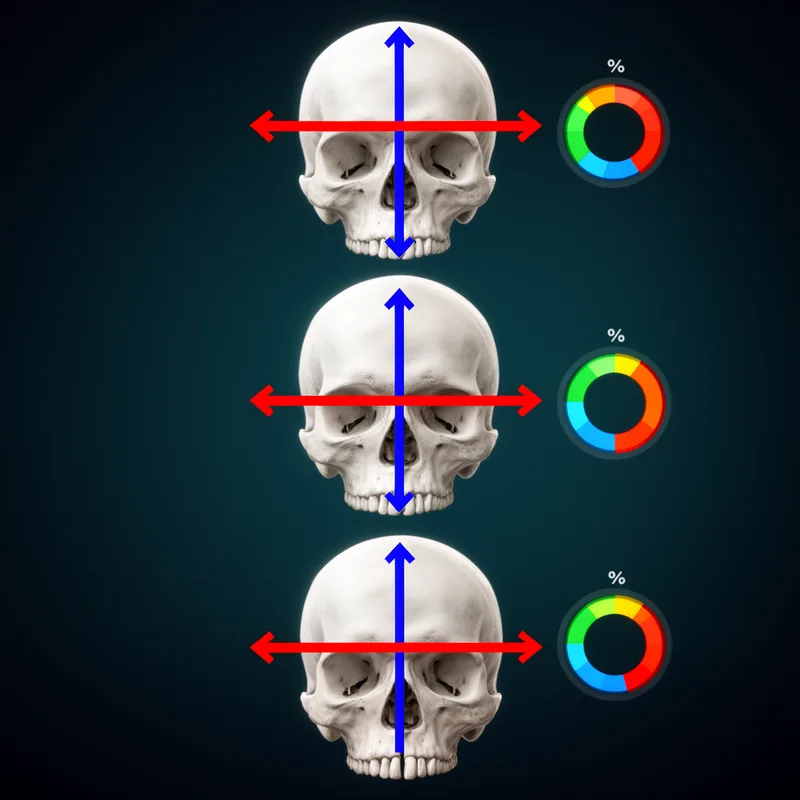
cephalic index
- noun
- /səˈfælɪk ˈɪndɛks/
- Specialized
- Researchers calculated the cephalic index to compare skull shapes among ancient populations.
Examples
-
A cephalic index above 80 is classified as brachycephalic.
-
The measurement of the cephalic index can provide insight into evolutionary adaptations.
-
The cephalic index is crucial for anthropological studies.
-
Researchers measure the cephalic index to understand skull shapes.
-
The researchers found that the cephalic index of this population indicated a trend towards brachycephalic skull shapes.
-
To study variations in human skulls, anthropologists often measure the cephalic index of different groups.
-
Understanding the cephalic index is essential for classifying the evolutionary traits of various human ancestors.
Synonyms
The percent of a skull's maximum width compared with its maximum length

The skull's widest measurement as a percent of its longest measurement
How Broad

Surface Forms
Morphology
Knowing 'cephalic' (head-related) and 'index' (a numeric indicator) lets a learner infer this is a numeric measure relating to the head or skull, so the general idea is predictable. However, the precise sense — that it is a specific ratio of maximum breadth to maximum length used in anthropology/medicine — is technical and not fully derivable from the constituents alone, so the term is only partially transparent.
Etymology
The term cephalic index comes from the Greek-based word cephalic, from 'head', and the Latin word index, meaning 'a number that compares'. So cephalic index literally means 'a number that compares head width to head length', which is why people use it to describe and compare head shape.

