
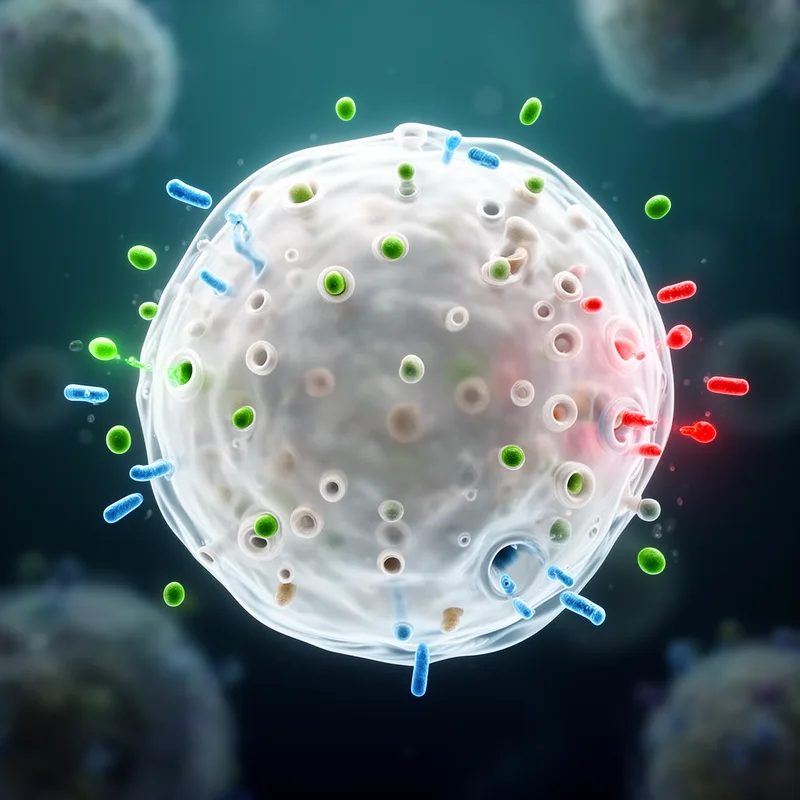
cell membrane
 4
3.6
4
3.6

- noun
- /sɛl ˈmɛmˌbreɪn/
- Specialized
- The cell membrane regulates which substances can enter and exit the cell.
- cell membrane permeability
- damage the cell membrane
- fungal cell membrane
Loading YouTube…
Watch on YouTubeAnd the Golgi apparatus puts layers of cell membrane around this this, this new protein.
- And the Golgi apparatus puts layers of cell membrane around this this, this new protein.
- Your brain is made of fat and your cell membranes are made of fat and cholesterol.
- Saprin is safe because it doesn't cross cell membranes.
- Neurons run on the passage of ions like sodium in and out of their cell membranes, or I should say across their cell membranes to be accurate.
Examples
-
Your brain is made of fat and your cell membranes are made of fat and cholesterol.
-
Chlorhexidine, which is an antiseptic that is effective against Gram-negative and Gram-positive bacteria, disrupts cell membranes.
Academic text (2018) -
And they usually do that with a cell membrane or a cell wall.
-
And then after the cell dies, the cell membrane gets stripped away.
-
You therefore have to make some holes in this hydrophobic cell membrane to allow things in and out.
-
They make up the cell membranes that keep cells intact.
-
Proteins embedded in a cell membrane shuttle hydrogen, sodium, potassium, and other ions into and out of the cell.
Academic text (2012) -
In human and animal cell membranes, cholesterol is the major sterol constituent.
Academic text (2006) -
Zervamicin is an antibiotic that is known to transport potassium ions across cell membranes.
Academic text (2001) -
Irradiation modifies the genes and cell membranes of microorganisms, killing or severely injuring them.
Academic text (2005)
Synonyms
 74
4.5
74
4.5
A thin, flexible layer that covers or separates parts of a living thing and acts as a barrier in technology
 1
4.5
1
4.5
A thin flexible layer around a cell that controls what enters and leaves it

A thin cover of two layers around a cell that controls what goes in and out
How Thick

Surface Forms
Morphology
The meaning 'the thin outer layer surrounding a cell' is directly and transparently derived from combining 'cell' (a microscopic living unit) with 'membrane' (a thin semi-permeable layer). This straightforward noun–noun compositional pattern is cross-linguistically common, so a B1 learner who knows both constituents should readily understand the MWE.
Etymology
Cell membrane is a clear picture: cell is the tiny living part and membrane means a thin skin or layer. Imagine a soft skin that wraps the cell and lets things pass through or stop them, so cell membrane means the thin outer layer that protects the cell and controls what goes 'in' and 'out'.