
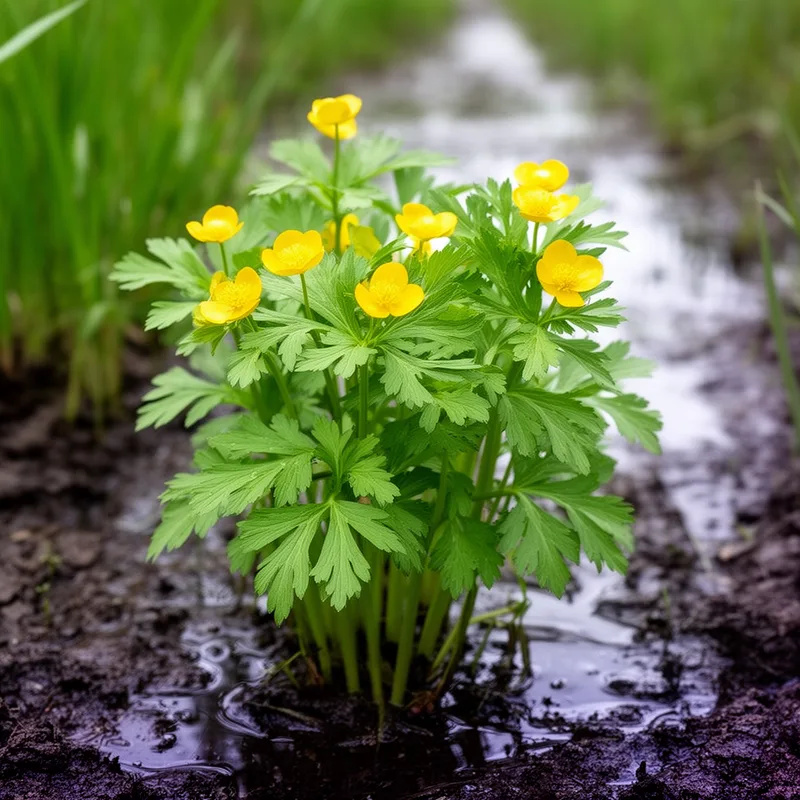
celery-leaved buttercup
- noun
- Specialized
- The celery-leaved buttercup thrives in wet meadows and marshy ditches.
Examples
-
We identified the celery-leaved buttercup by its bright yellow flowers and deeply divided leaves.
-
The celery-leaved buttercup is commonly found near ponds and marshes, where it flourishes in wet soil.
-
Gardeners often avoid planting celery-leaved buttercup due to its toxic properties.
-
Look at that celery-leaved buttercup!
-
The celery-leaved buttercup thrives in wetland areas.
-
We spotted a patch of celery-leaved buttercup growing alongside the river, its leaves resembling those of celery.
-
In the spring, the celery-leaved buttercup blooms with bright yellow flowers, adding color to the moist landscape.
Synonyms
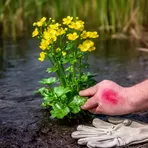
A yearly buttercup that grows in wet places and can cause skin irritation

An annual marsh plant with divided leaves and small flowers
Surface Forms
Morphology
celery-leaved + buttercup
The compound is compositionally transparent: 'celery-leaved' means 'having leaves like celery' and combined with 'buttercup' yields a buttercup with celery-like leaves, so the overall meaning is directly derivable from its parts. Although botanical, this descriptive naming follows common adjective + noun patterns found across languages, making it readily understandable to a B1 learner who knows the constituent words.
Etymology
Celery-leaved buttercup is named because the plant's leaves look like celery and it is a kind of buttercup with bright yellow flowers. So the name means 'an herb with celery-like leaves and buttercup flowers' and points to the plant you find in wet places.

