
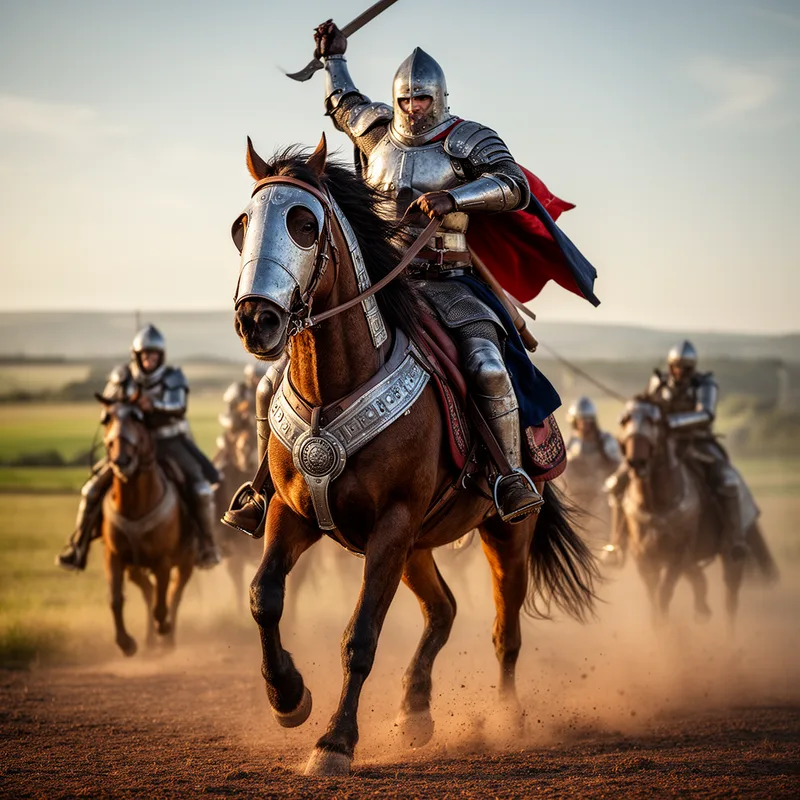
cavalry horse


 1
6.2
1
6.2
- noun
- During the parade, the cavalry horses displayed their training with precise movements.
Examples
-
The soldiers rode their cavalry horses into battle with confidence and skill.
-
"It's an old cavalry horse," he said.
Fiction book (1990) -
The mare was no cavalry horse.
Fiction book (1990) -
Three shod, one outrider, two cavalry horses.
-
You're going on an expedition to buy cavalry horses In the tatar Countries.
-
Colonel Hawker comes down from lndia every year and faithfully buys up the best cavalry horses in the country.
-
The king's infantry slouched around in a deceptive disarray, while the cavalry horses stood fully geared, pawing, sleeping, or lipping the ground as temperament decreed.
Fiction book (1990) -
Every year, the army inspects its cavalry horses to ensure they are ready for deployment.
Synonyms
 17
9.6
17
9.6
A strong, fast horse used for riding in battle
 1
9.0
1
9.0
A strong horse trained to carry soldiers into battle

A strong fast horse used in battle or hunting long ago
How Trained

Surface Forms
Morphology
The meaning is directly and transparently built from 'cavalry' (soldiers fighting on horseback) + 'horse' (an animal used for riding), yielding a horse used by cavalry. This is a straightforward compositional noun phrase and follows predictable cross-linguistic patterns, so a B1 learner who knows both constituents will understand it.
Etymology
Cavalry horse comes from soldiers who fought while riding horses. Imagine a soldier on a strong horse in a group called the cavalry, charging into battle, so it means 'a horse specially trained to carry soldiers in war'.