
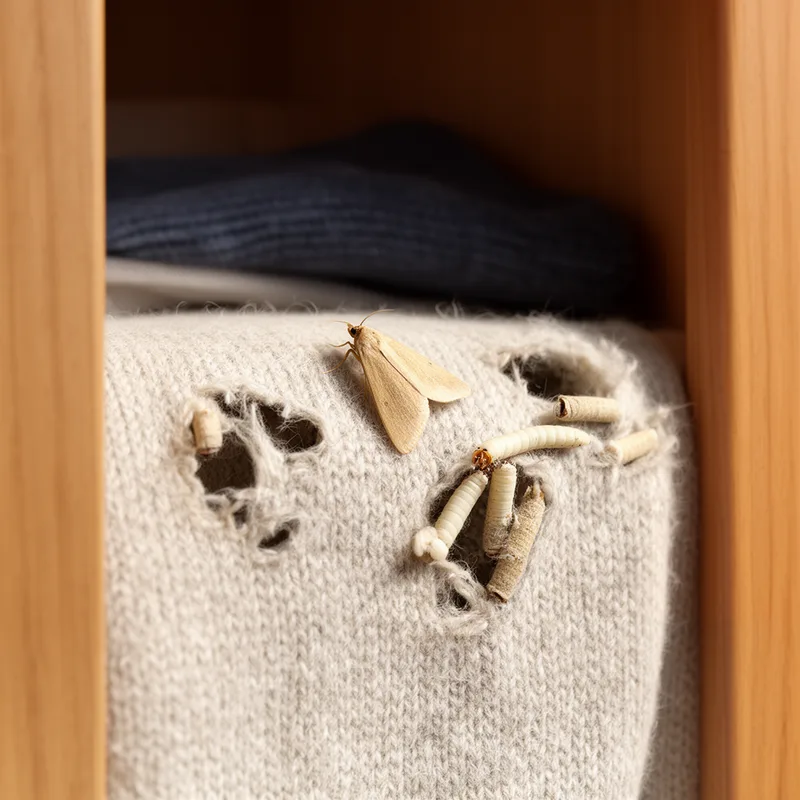
casemaking clothes moth
- noun
- /ˈkeɪsˌmeɪkɪŋ kloʊðz mɔθ/
- The casemaking clothes moth is responsible for many holes found in wool sweaters and carpets.
Examples
-
Conservation labs use special techniques to protect textiles from the casemaking clothes moth.
-
Have you ever seen a casemaking clothes moth in your closet?
-
A single casemaking clothes moth infestation can destroy valuable fabric collections if left untreated.
-
The casemaking clothes moth is known for damaging fabrics.
-
A single casemaking clothes moth infestation can destroy valuable fabric collections if left untreated.
-
The casemaking clothes moth is responsible for many holes found in wool sweaters and carpets.
-
Conservation labs use special techniques to protect textiles from the casemaking clothes moth.
Synonyms

A small moth whose larvae live in silk tubes and eat cloth made from natural fibers

A young insect that builds and lives in a small case made from silk and bits of leaves or sand
A small insect whose young eat wool and make holes in clothes

A small moth or caterpillar that lives inside a tiny case made of silk and plant pieces
A small yellowish moth whose caterpillars eat wool, fur and other animal fibers
Surface Forms
Morphology
The phrase is compositionally built from 'clothes' + 'moth' (a moth that affects clothing) with a modifier 'casemaking' that literally suggests 'making cases.' While learners who know 'clothes' and 'moth' can infer it is a type of moth that damages clothes, the specialized sense of larvae living in silk tubes ('case-making') is technical and not fully predictable for a B1 learner.
Etymology
Casemaking clothes moth gets its name from the moth's young, which make and carry tiny tubes or 'cases' from bits of fabric and silk to live in, so the word casemaking is literal. Because they eat wool and other clothes and can leave holes, the name also shows they are a clothes moth that can 'damage' your clothes.

