

Tinea pellionella
- noun
- Specialized
- The larvae of Tinea pellionella often hide in silken tubes they create from the fabric they consume.
Examples
-
The larvae of Tinea pellionella can cause serious damage to woollen garments.
-
Scientists studied the unique silk tubes spun by Tinea pellionella for protection.
-
Tinea pellionella is commonly found in households where natural fibers are present.
-
The Tinea pellionella is known for damaging wool garments.
-
Have you heard of Tinea pellionella?
-
Tinea pellionella is a common pest in homes that have a lot of wool and silk fabrics.
-
Damage caused by Tinea pellionella can be avoided by regularly cleaning and vacuuming your closet.
Synonyms

A small moth whose young caterpillars live in little tubes and eat fabrics
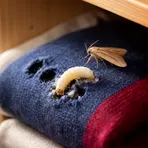
A small insect whose young eat wool and make holes in clothes
Surface Forms
Morphology
Tinea + pellionella
The element 'Tinea' identifies a moth genus, so a learner who knows that can infer this is a kind of moth; however 'pellionella' is not a meaningful English word and the binomial is a proper scientific name. The precise species-level meaning (a clothes moth whose larvae damage fabrics) is not derivable from ordinary word composition, so the expression is only partially transparent.
Etymology
Tinea pellionella may come from Latin words: Tinea originally meant a small moth or 'worm', and pellionella is a little form of a word for 'skin' or 'fur', because the young larvae live in silken tubes inside clothing and eat natural cloth. So the name points to a small moth that lives in and damages fabric.

