
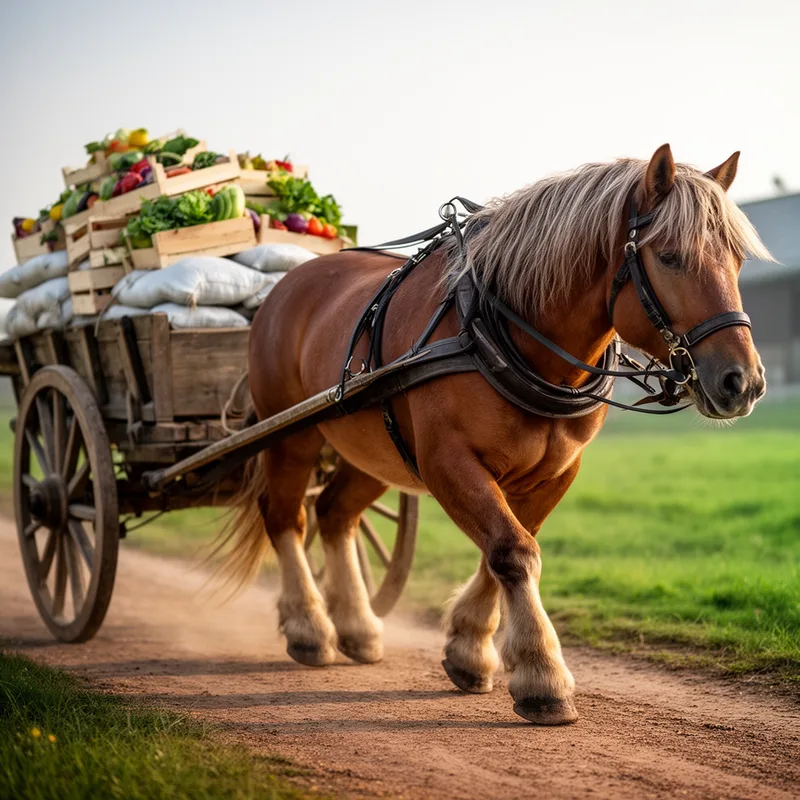
cart horse


 1
3.2
1
3.2
- noun
- " And then she saw the flash of fire that scratched the air with gold and turned a rearing cart horse into a tree with diamond leaves."
Examples
-
He slept that night where cart horses were stabled and drank from the animals' trough.
Fiction book (1993) -
"I think he can get down." "He says he's grown used to finding himself in odd places when the bird changes." "Where did you find him in Ro Holding?" "He flew over the walls of Ro House and started turning cart horses into trees with diamond leaves."
Fiction book (1993) -
He could be a cart horse or a lead pony.
-
Them stables couldn't train a cart horse to a pull wagon.
-
The Gatekeeper, struggling with a panicked cart horse, shouted at her.
Fiction book (1993) -
It was a battle, Nyx realized, taking a closer look, depicted with ruthless and startling detail: not even the cart horses seemed exempt from slaughter.
Fiction book (1993) -
The farmer bought a cart horse to help transport goods to the market.
-
After a long day of work, the cart horse rested by the stable with its harness removed.
-
In the old town, the cart horse pulled the wooden cart filled with fresh produce.
Synonyms
 1
3.8
1
3.8
A large strong horse that pulls heavy loads like a cart or plow
 1
3.4
1
3.4
A strong horse used to pull heavy loads on a farm
 1
7.7
1
7.7
A large strong animal that pulls heavy carts or wagons
 1
9.6
1
9.6
A large strong horse used to pull heavy carts or wagons

A large strong horse that pulls heavy carts or wagons

A horse trained to pull a cart or carriage
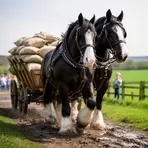
A very large strong British horse used to pull heavy loads like carts
How Strong

Surface Forms
Morphology
The meaning 'a horse that pulls carts or heavy loads' is directly and transparently derived from combining 'cart' (a wheeled vehicle) with 'horse' (the animal), i.e. a horse used for carts. This straightforward noun–noun compounding is cross-linguistically common and a B1 learner who knows both constituents would readily infer the intended meaning, despite the additional detail about specialized breeding.
Etymology
Cart horse comes from the simple picture of a horse tied to a cart, pulling heavy loads on farms and in towns. People used these strong animals for 'pulling' or 'carrying' goods, so the name came to mean a horse bred and used for that work.