

to camber


 1
7.7
1
7.7
- verb
- /ˈkæmbər/
- Specialized
- The engineer decided to camber the road to enhance water drainage after heavy rains.
- cambered sole
Examples
-
For example, he developed a theory for calculating the lift and pitch-related moment coefficients for thin, cambered airfoils; his thin-airfoil theory, developed during World War I, allowed the first practical calculations of airfoil properties and is still used today.
Academic text (2005) -
Cambering the wheels can help increase the effective wheelbase track and improve pushing ergonomics.
Academic text (1993) -
(Gomez camber up to the window.)
Fiction book (1999) -
Some of the modifications have included: lowering the seat, cambering the rear wheels and moving them forward, changing the diameter of the rear wheels and the pushrims, and finally, modifying the frame (2).
Academic text (1992) -
Frost and sympathetic members of the Society had spent countless hours attaching duck feathers to the cambered frames, which were hinged in the middle and connected to the engine by coiled Bourdon tubes.
Fiction book (1999) -
For optimal performance, the builder will camber the beams to provide better support.
-
They planned to camber the bicycle tires for improved handling on turns.
Synonyms
 268
1.0
268
1.0
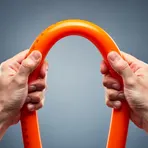
To make something curved instead of straight
Antonyms
Compounds

- Specialized
An arch with a flat top and a slightly curved bottom used in doorways or bridges
How Curved

Surface Forms
Etymology
The verb camber comes from the old French cambrer, meaning 'to bend' or 'arch'. To camber a beam or wheel is simply to give it a slight 'curve' so it will not sag or will drain properly.