
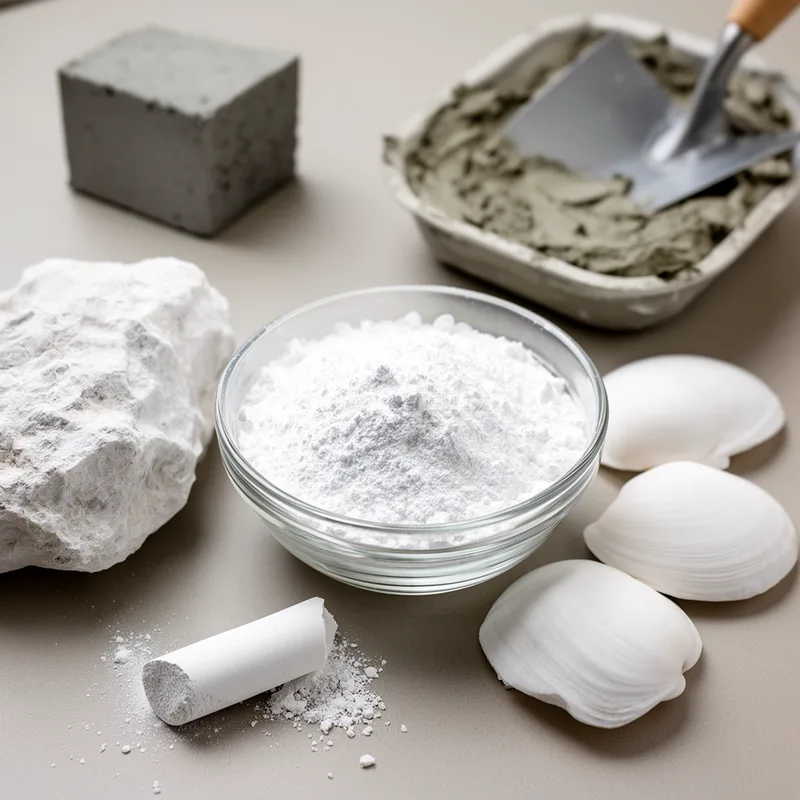
calcium carbonate
 3
3.9
3
3.9

- noun
- /ˈkæl.si.əm ˈkɑːr.bə.neɪt/
- Specialized
- "Di-Gel contains calcium carbonate, an effective antacid..."
Loading YouTube…
Watch on YouTubeNow this product is basically calcium carbonate that's ground in a very, very special way, and we can get into those details.
- Now this product is basically calcium carbonate that's ground in a very, very special way, and we can get into those details.
- It it, you know, leaves its residue of calcium carbonate, I think behind on the thing rather than graphite, rather than ink.
Examples
-
We're going to take a few spoonfuls of the Gilder's Wipe calcium carbonate and put it into a large mixing bowl.
-
"It's made of calcium carbonate and ancient seashells.
Fiction book (1999) -
Now this product is basically calcium carbonate that's ground in a very, very special way, and we can get into those details.
-
And most of the bottom of the ocean is got calcium carbonate oozing it.
-
It's the stone that I told you about before I left: a calcium carbonate called tufa, the texture and color of sand.
Fiction book (2002) -
Those are mainly calcium carbonate with some magnesium and some manganese.
-
A number of trace elements in seawater can substitute for calcium in the calcium carbonate matrix.
Academic text (2008) -
As they do so, they secrete calcium carbonate, adding their minute contribution on top of the accumulated skeletons of millions of years.
Academic text (2009) -
Corrosive water prevents a film deposition of the chemical calcium carbonate from forming on the piping surface.
Academic text (1993) -
The abalone, for example, makes its shell out of calcium carbonate, the same stuff as soft chalk.
How Hard

Surface Forms
Morphology
The term names a chemical compound made from the constituent parts: calcium (the metal/ion) + carbonate (the CO3(2-) anion), so its meaning as a calcium salt of carbonate is directly compositional. This systematic naming pattern is predictable and cross-linguistically similar, so a learner who knows both constituents can infer the basic meaning (a mineral/white solid composed of calcium and carbonate).
Etymology
Calcium carbonate is a name made from two parts: calcium, from an old word for 'lime', a white powder people used long ago, and carbonate, which shows the substance contains carbon. So the name tells us it is a common white mineral 'made of' calcium and carbon, and that is why it appears in chalk, shells, and limestone.