
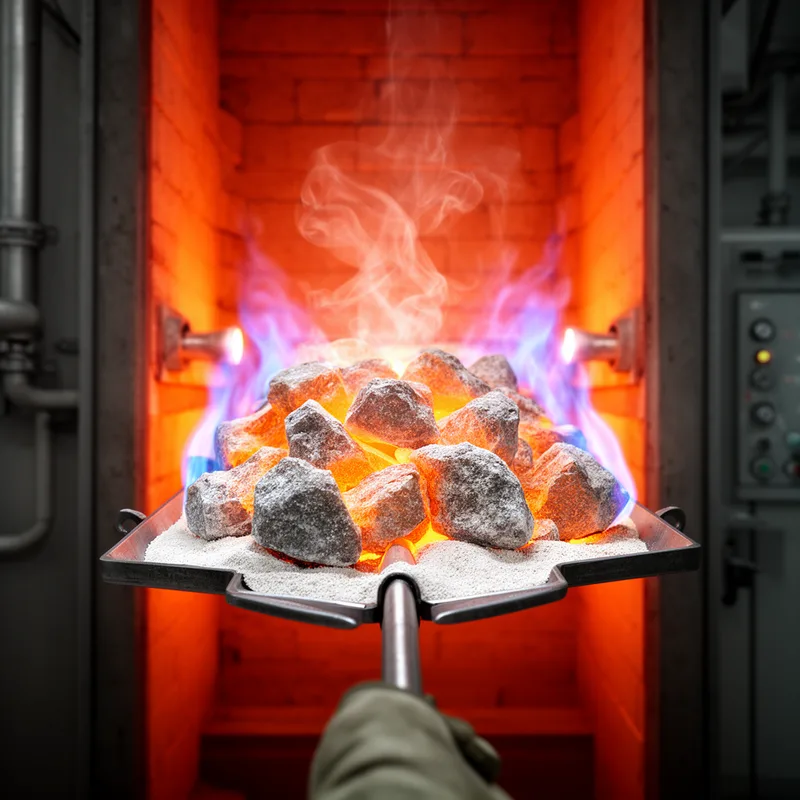
calcination
- noun
- /ˌkæl.sɪˈneɪ.ʃən/
- Specialized
- Chemical engineers study calcination to improve the efficiency of metal production.
- calcination temperature
Examples
-
Swollen tight with vanity, he would pump his ancient bellows to undertake the magisterial yet tenebrous concept of reverberation, putrefaction, extraction, calcination, final projection, reduction, and the like.
Fiction book (1991) -
Indeed, depending on the policies and procedures in place, an on-site investigation is conducted following the fire to determine the chronology, origin, and cause of the fire based on the exploitation and interpretation of the marks left by the fire (e.g., calcination marks) 61,62.
Academic text (2017) -
This is the calcination of limestone.
-
" I've performed the first three steps: calcination, solution, and separation.
Fiction book (1993) -
Nevertheless, works fluctuate as do their private mercuries because of calcination.
Fiction book (1991) -
The obtained sample was denoted as SiO2-TPAOH-T (T is the calcination temperature).
Academic text (2018) -
The subsequent procedure was the same as the preparation of SiO2-NH3-H2O, and the calcination temperature of SiO2-TPAOH ranged from 350 to 550 °C.
Academic text (2018) -
In 1996, he established that sintering of metal particles (which should be avoided because it decreases surface area) occurred during calcination (oxidizing atmosphere), but could be minimized if the calcination was performed slowly at temperatures low enough for the ammonia to be lost without decomposition.
Academic text (2001) -
In 1996, he established that sintering of metal particles (which should be avoided because it decreases surface area) occurred during calcination (oxidizing atmosphere), but could be minimized if the calcination was performed slowly at temperatures low enough for the ammonia to be lost without decomposition.
Academic text (2001) -
The calcination of clay transforms it into a useful material for ceramic production.
Synonyms

 1
9.9
1
9.9

The breaking of materials like wood or plastic by very high heat into simpler parts
Breaking a material into simpler parts using heat
How Heated

Surface Forms
Morphology
Etymology
Calcination comes from the Latin calx, meaning 'lime' or 'stone', and this same root appears in words like calcium and chalk. So, people used the word for heating limestone to make lime, and today calcination means heating a material very strongly to change it, for example to turn metals into oxides or to remove unwanted parts by heat.