
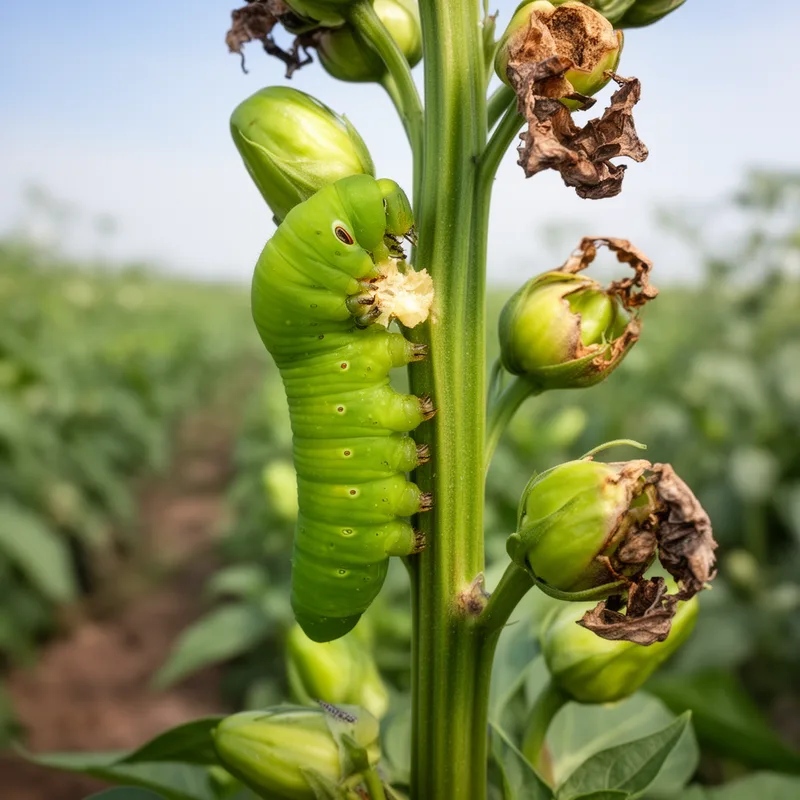
budworm
- noun
- /ˈbʌdˌwɜrm/
- "Cotton bollworms and budworms have developed resistance to many standard commercial insecticides," says Kirk, who is with the Areawide Pest Management Research Unit in College Station.
- budworm and bollworm
- budworm population on cotton
- tobacco budworm
Examples
-
Spinosad Tests on Cotton Pests: Bollworms and Budworms
Academic text (2000) -
However, cotton treated with spinosad had fewer damaging bollworm and budworm larvae than plots treated with the other pesticides," Esquivel says.
Academic text (2000) -
This helps prevent budworms or helps keep them at Bay.
-
Bermuda beach improved again and see some budworm damage.
-
Extremely high pesticide resistance had developed in the tobacco budworm population on cotton.
Academic text (1992) -
Effective management of the timber resource to provide a maximum sustainable yield on a regional basis would lead to conditions less suitable for budworm outbreaks.
Academic text (1990) -
Finally, in early 1970, approximately 285,000 ha of cotton had to be abandoned because pesticides were ineffective and there was no way to protect the crop from the budworm.
Academic text (1992) -
In fact, like its "partners in crime"—tobacco budworm and cotton bollworm—it was recently added to the list of cotton pests that are showing resistance to insecticides.
Academic text (1999) -
The tobacco budworm infests the young leaves of tomato plants, causing significant damage to the crops.
-
Farmers are concerned about the budworm outbreak as it threatens to destroy their fruit blossoms this spring.
Synonyms

 43
1.0
43
1.0

A soft young insect like a worm that becomes a butterfly or moth and eats leaves

A small caterpillar that eats crops like cotton, corn, and tomatoes
Compounds
How Damaging

Surface Forms
Morphology
Etymology
Budworm comes from the simple parts bud and worm. Bud means 'a young leaf or flower' and worm has long been used for 'a small soft creature', often the young form of an insect like a caterpillar, so a budworm is a young insect that eats plant buds and can damage new growth.