

codling moth
- noun
- /ˈkɒdlɪŋ mɔθ/
- Specialized
- The codling moth larva can cause significant damage to apples and walnuts if left untreated.
- apples with codling moth
- codling moth control
Examples
-
Mating disruption, a biological intervention, is only the latest strategy employed in a century of war with the codling moth.
Fiction book (1999) -
However, "Chemical sprays are not as effective as they once were for controlling codling moths in our orchards," says John Biele, a fruit grower in northern Washington.
Academic text (1995) -
Overall, codling moth damage was reduced at this site too.
Academic text (1997) -
Fruit growers back new approach to codling moth control.
Academic text (1995) -
But it proved only fair for codling moths and variable for stinkbugs.
Academic text (2000) -
In time, populations of codling moths dwindle to acceptable numbers.
Fiction book (1999) -
There's also the risk that codling moths will become resistant to currently registered insecticides.
Academic text (1997) -
But by the 1920s, codling moths had become established, and growers were spraying trees once or twice a year.
Academic text (1995) -
Another component of the area-wide project is the release of sterile codling moth males.
Academic text (1995) -
Now, some growers need to apply insecticides for codling moth control up to six times a year, as insecticide resistance increases.
Academic text (1995)
Synonyms
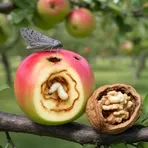
A small grey moth whose young caterpillars eat the inside of apples and walnuts, damaging the fruit

A small grey moth whose larvae eat apples and walnuts
How Damaging


Surface Forms
Morphology
The compound is compositionally built: 'codling' (a small apple) modifies 'moth', so a B1 learner who knows both words can infer it is a moth associated with or feeding on codlings/apples. This host-based noun+noun naming pattern is transparent and common cross-linguistically, so the overall meaning is derivable from the constituents.
Etymology
The name codling moth may come from the old word codling, which meant a 'small apple'. The moth's caterpillars hide and eat inside apples and walnuts, so the name points to a moth that damages fruit.