
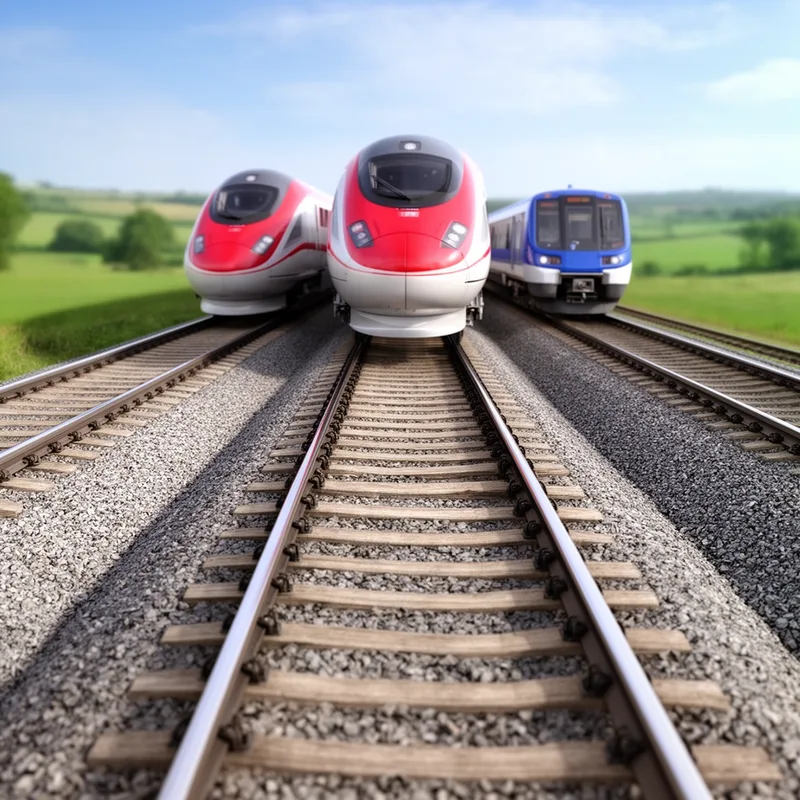
broad gauge
- noun
- Specialized
- The Great Western Railway was one of the first to have a livery, and Isambard Kingdom Brunel also distinguished his railway by having a broad gauge of seven feet.
Examples
-
In the 19th century, many railways in Britain adopted a broad gauge for faster services.
-
The railway line uses a broad gauge to support heavier trains and increase capacity.
-
You got broad-gauge iron bars on every door, vent and window.
-
Discussion here of town founding in the Willamette Valley has been largely structural and broad-gauge.
Academic text (2006) -
The new train system is designed for broad gauge tracks, allowing it to transport larger loads.
How Wide


Surface Forms
Morphology
The meaning 'a railway track wider than the standard gauge' is directly derivable from combining 'broad' (wide) with 'gauge' (a measure/width), following a straightforward adjective + noun composition. Although somewhat technical, the phrase is compositional and a B1 learner who knows both words should be able to infer the intended meaning.
Etymology
Broad gauge comes from early railways and names tracks where the two rails are set farther apart than normal. Here broad means 'wider' and gauge means the 'distance between the rails', so the image of rails spread out helps you remember it means tracks with a larger width to carry bigger, more stable train cars.