
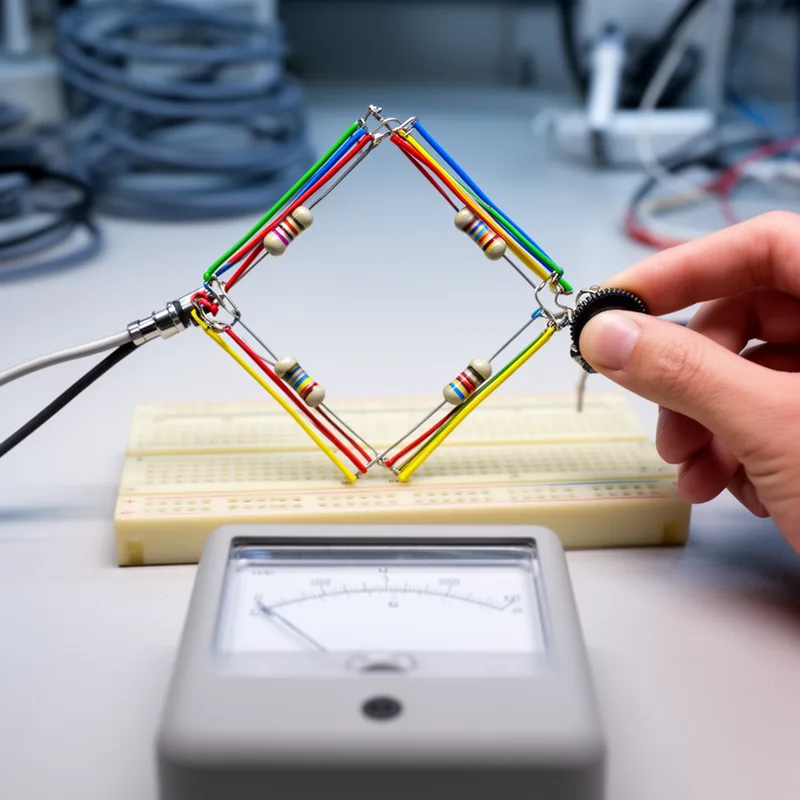
bridge circuit
- noun
- /brɪdʒ ˈsɜrkɪt/
- Specialized
- The difference in the resistance of the RTD in the active catalytic element relative to the reference RTD is measured using a bridge circuit.
- Wheatstone bridge circuit
Examples
-
Each strain gauge element had its own Wheatstone bridge circuit.
Academic text (1993) -
The Wheatstone bridge circuit is commonly used in laboratories to measure electrical resistance.
-
DIAGRAM: Figure 4. Wheatstone Bridge circuit.
Academic text (1993) -
The H-bridge circuit relied on the idea of the transistor as a switch.
Academic text (2014) -
Strain gauge bridge circuits in the force plate were excited with 4.5 volts.
Academic text (1990) -
Strain gauge bridge circuits in the force plate were excited with 4.5 volts.
Academic text (1990) -
The unit is designed to be connected to three full Wheatstone bridge circuits, a circuit typically used in strain-gage force transducers.
Academic text (1995) -
The unit provides bridge balancing, amplification, and filtering for three channels of Wheatstone bridge circuits.
Academic text (1995) -
Early work on this had been done in 1839 by Cooke and by Wheatstone, the inventor of the bridge circuit that bears his name.
Academic text (2011) -
The change in resistance is measured as a voltage, E, output by a Wheatstone bridge circuit in a "quarter-bridge" configuration (Figure 4).
Academic text (1993)
Synonyms
 3
7.5
3
7.5

An electrical circuit shaped like a diamond used to measure resistance
A circuit that measures how strongly a part stops electric current by balancing two sides
How Complex

Surface Forms
Morphology
The phrase is partly compositional: a B1 learner who knows 'bridge' (something that connects) and 'circuit' (an electrical path) can infer it denotes a kind of circuit that bridges or connects branches. However, the precise technical sense (the specific diamond/bridge arrangement used for accurate measurement, e.g. a Wheatstone bridge) is specialised knowledge beyond ordinary word meanings, so the full meaning is not predictable from the parts alone.
Etymology
The noun bridge circuit comes from the image of a bridge joining two paths of wire: the circuit makes two sides and a meter sits across the middle like a plank between them. Because the meter uses that bridge to 'compare' the two sides, the name means a circuit used to 'measure' electrical values.