
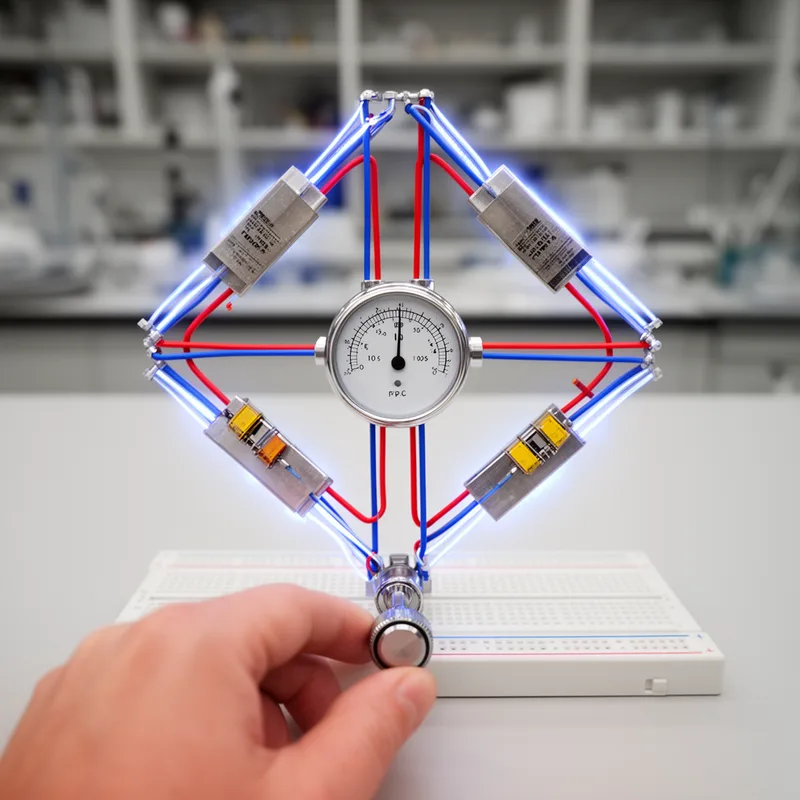
Wheatstone bridge
- noun
- /ˈwiːtstoʊn brɪdʒ/
- Specialized
- The technician set up a wheatstone bridge circuit to accurately measure the resistance of an unknown component.
- Wheatstone bridge circuit
- Wheatstone bridge output
Examples
-
The resistance thermometer measures temperature changes through the use of a resistor and a Wheatstone bridge that measures the resistance change resulting from a temperature change.
Academic text (2005) -
The change in resistance is measured as a voltage, E, output by a Wheatstone bridge circuit in a "quarter-bridge" configuration (Figure 4).
Academic text (1993) -
Each strain gauge element had its own Wheatstone bridge circuit.
Academic text (1993) -
The potentiometers to balance the Wheatstone bridges are accessible through holes in the plastic housing.
Academic text (1995) -
The unit is designed to be connected to three full Wheatstone bridge circuits, a circuit typically used in strain-gage force transducers.
Academic text (1995) -
Instrumentation amplifiers built into the sensor boost the signal level of the Wheatstone bridge output before A/D conversion.
Academic text (1998) -
Gages were configured in two four-arm Wheatstone bridges.
Academic text (1992) -
The unit provides bridge balancing, amplification, and filtering for three channels of Wheatstone bridge circuits.
Academic text (1995) -
Each strain sensing element of the rosette was connected to a Wheatstone bridge in a quarter-bridge pattern.
Academic text (1995) -
The amplified voltage output from each Wheatstone bridge passed through a fourth-order Butterworth active low-pass filter with a nominal signal cutoff at 30 Hz.
Academic text (1993)
Synonyms
 3
7.5
3
7.5

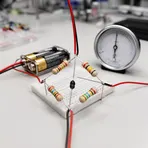
An electrical circuit shaped like a diamond used to measure resistance
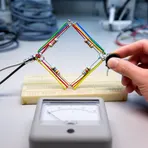
An electric circuit in a diamond shape that measures resistance when you connect a meter across it
How Complex

Surface Forms
Morphology
Wheatstone + bridge
This is an eponymous technical term: 'Wheatstone' is a proper name and does not contribute predictable semantic content, while 'bridge' is general; the specific meaning (a particular balanced circuit for measuring resistance) is a specialised concept that cannot be derived from the parts. A B1 learner who knows the words would not be able to infer the precise technical function or measurement purpose from the constituents alone, so the expression is opaque.
Etymology
The Wheatstone bridge is named after Sir Charles Wheatstone, who built a clever electric device in the 1800s. The device has four parts that form a shape like a small bridge, and when the bridge is 'balanced' it shows the size of an 'unknown resistance', so the name helps you remember it is used to 'measure resistance'.