
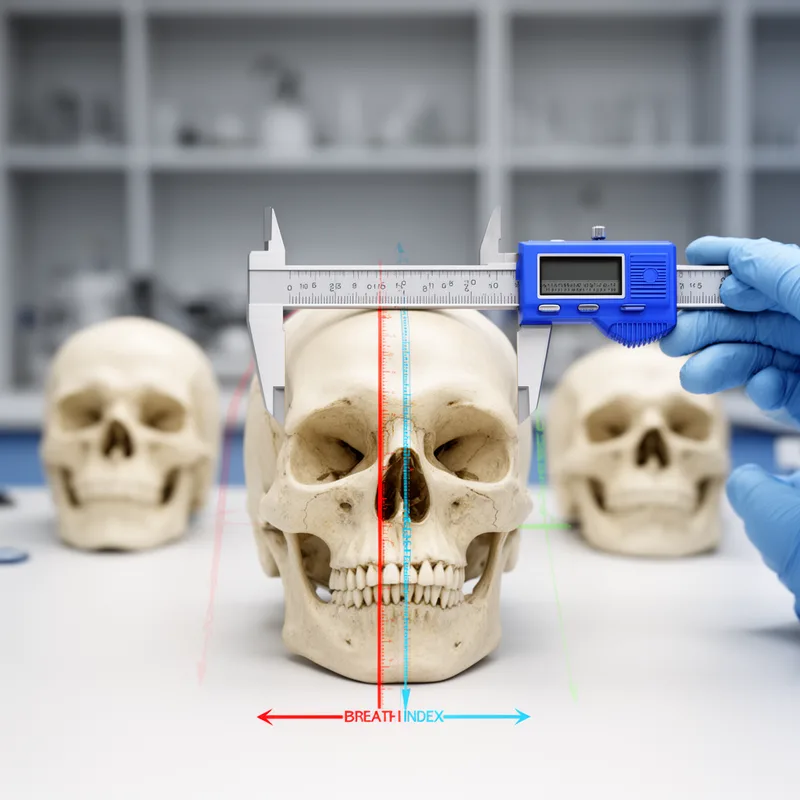
breadth index
- noun
- /brɛdθ ˈɪndɛks/
- Specialized
 :
índice de amplitud
:
índice de amplitud
- The breadth index is an important measurement in anthropological classification of skull shapes.
Examples
-
A scientist calculated the breadth index to compare the cranial features of different populations.
-
The breadth index of the skull is crucial for anthropological studies.
-
Changes in the breadth index may reflect evolutionary adaptations over time.
-
Can you calculate the breadth index for this sample?
-
A scientist calculated the breadth index to compare the cranial features of different populations.
-
The breadth index is an important measurement in anthropological classification of skull shapes.
-
Changes in the breadth index may reflect evolutionary adaptations over time.
Synonyms

The percent of a skull's width compared with its length used to describe skull shape

The percent of a skull's maximum width compared with its maximum length
Surface Forms
Morphology
The noun combination clearly signals a numeric measure related to width because 'breadth' means side-to-side measurement and 'index' denotes a numeric indicator, so learners will expect a measure involving breadth. However, the exact formula (percentage ratio of maximum width to maximum length of a skull) and its anatomical application are domain-specific and not fully predictable from the parts alone, so it is only partially transparent to a B1 learner.
Etymology
Breadth index comes from measuring: breadth means the skull's widest part ('width') and index means a number that shows a comparison. Scientists measure the skull's widest and longest parts, turn that result into a percent, and use the number to 'compare' skull shapes.

