

to book up
 10
3.5
10
3.5

- phrasal verb
- /bʊk ʌp/
- But again, they do tend to book up early.
- booked up months in advance
- hotels are already booked up
- booked up for the weekend
Examples
-
Woo called a car service for you, but they were all booked up.
Fiction book (1994) -
There are going to be a lot of seniors battling for appointments during this period of time, so don't wait until your advisor is all booked up to try to set up a meeting.
Blog text (16) -
Well, they said they were all booked up.
-
Our car's all booked up for tomorrow.
-
I wish I could help, but we're completely booked up.
-
The restaurants were booked up days in advance.
Fiction book (2002) -
Also, I am quite surprised at how many flats are already booked up four months in advance.
Blog text (1) -
We are all booked up, but we do have the Kapua suite available.
-
"All the hotels were booked up for pets, and we have a dog and a mouse, so we decided to stay," she said.
Blog text (16) -
Hotel rooms can book up months in advance due to the market's popularity.
Synonyms
 439
1.8
439
1.8
To arrange for a seat, room, or ticket before you need it
 126
3.2
126
3.2
To book something in advance for future use
 114
2.7
114
2.7
Arrange for someone or something to be available when needed
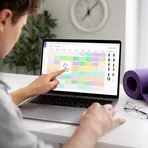
To arrange a time and reserve a place for a class or appointment
Surface Forms
Morphology
The core verb 'book' (to reserve) combined with the particle 'up' here conveys a completive/totaling meaning (reserve completely/all available), so the sense is partly derivable from the constituents. However, the specific nuance of reserving "all available places" and the phrasal-verb particle use of 'up' may not be fully predictable to a B1 learner without prior exposure, so the transparency is partial.
Etymology
Book up comes from the old practice of writing people's names in a reservation book. When the book was full or 'up', there were no places left, so the phrase came to mean 'to reserve all available places'.