
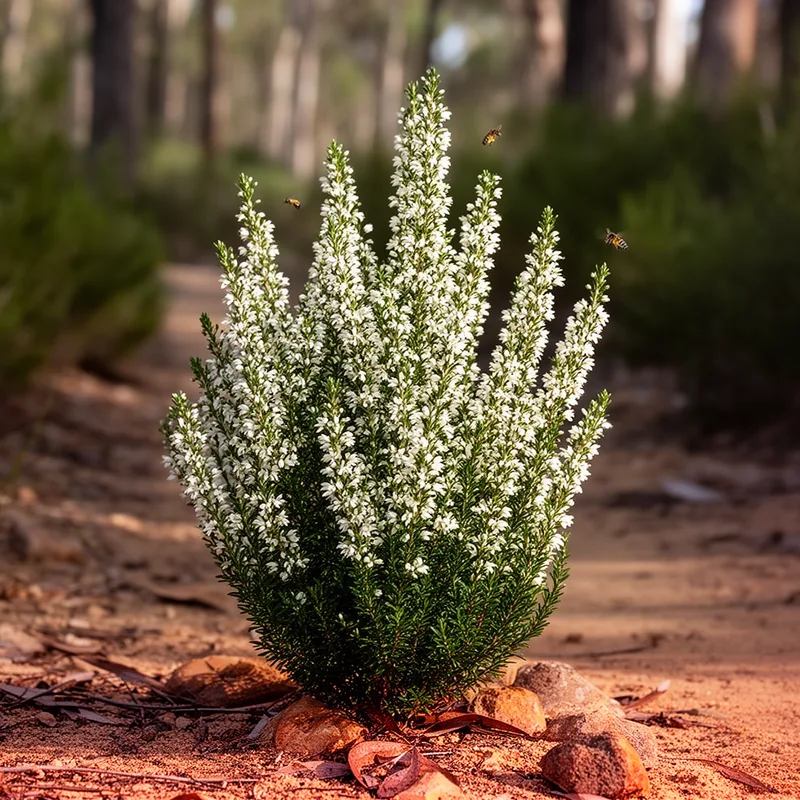
blunt-leaf heath
- noun
- Australian
 :
heath de hojas romas
:
heath de hojas romas
- The blunt-leaf heath blooms beautifully in the Tasmanian spring.
Examples
-
Gardeners value the blunt-leaf heath for its fragrant flowers and hardy nature.
-
We spotted several blunt-leaf heaths growing along the woodland trail.
-
The blunt-leaf heath blooms beautifully in spring.
-
Many gardeners love the blunt-leaf heath for its fragrant flowers.
-
Gardeners value the blunt-leaf heath for its fragrant flowers and hardy nature.
-
The blunt-leaf heath blooms beautifully in the Tasmanian spring.
-
We spotted several blunt-leaf heaths growing along the woodland trail.
Synonyms

A small upright shrub from Australia and Tasmania with fragrant ivory flowers

A small upright bush from Australia and Tasmania with sweet-smelling, colorful flowers
Surface Forms
Morphology
blunt-leaf + heath
The compound is compositionally transparent: a B1 learner who knows 'blunt' (not sharp) and 'leaf' can infer 'blunt-leaf' means having blunt leaves, and combined with 'heath' (a small shrub) yields a shrub with blunt leaves. This adjective+noun compounding follows regular English morphology and is cross-linguistically common, so the meaning is readily derivable from the parts.
Etymology
The name blunt-leaf heath may come from the simple look of the plant: its blunt leaves, meaning 'not sharp', and the fact it grows as a low heath or 'shrub'. That's why the name describes a small plant with rounded leaves and fragrant flowers.

