
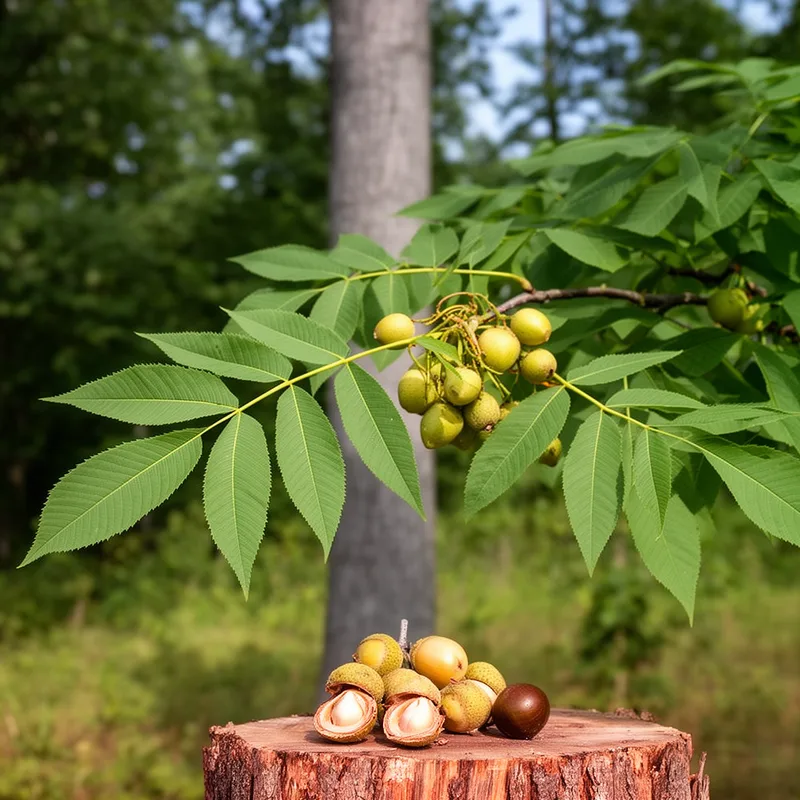
bitternut hickory
- noun
- US
- Although the nuts of the bitternut hickory are edible, their bitter taste makes them unpopular with people.
Examples
-
The wood from the bitternut hickory is valued for making tool handles and furniture.
-
The bitternut hickory tree grows tall and strong.
-
A mature bitternut hickory can reach heights of up to 35 meters in the wild.
-
Many bitternut hickories thrive in the Appalachian region.
-
The bitternut hickory is known for its distinctive leaves, which typically have 7 or 9 leaflets.
-
Many animals rely on the bitter nuts of the bitternut hickory as a food source during the colder months.
-
In Michigan, the bitternut hickory is often found in mixed forests alongside other native trees.
Synonyms

A hickory tree from eastern North America with leaves made of 7 or 9 small parts and thin, bitter nuts

A hickory tree with leaves that have seven or nine small parts and thin shelled nuts that taste very bitter

A tree in the eastern United States with leaves of seven or nine small parts and thin, very bitter nuts

A tree from the eastern United States with 7 or 9 leaflets and thin, very bitter nuts

A hickory tree that makes bitter thin-shelled nuts and the nut itself
Surface Forms
Morphology
The compound is directly compositional: 'bitternut' (a hickory with bitter nuts) modifies 'hickory' to denote a specific type of hickory, so the overall meaning — a species of hickory characterized by bitter nuts — is derivable from the parts. This noun‑noun naming pattern is a standard, cross‑linguistic way to form species/variety names and would be transparent to a B1 learner who knows the constituents.
Etymology
Bitternut hickory is a very literal name: it labels a hickory tree whose nuts taste very bitter. That's why the phrase points to a tree with 'bitter' nuts and now names this kind of tree today.

