
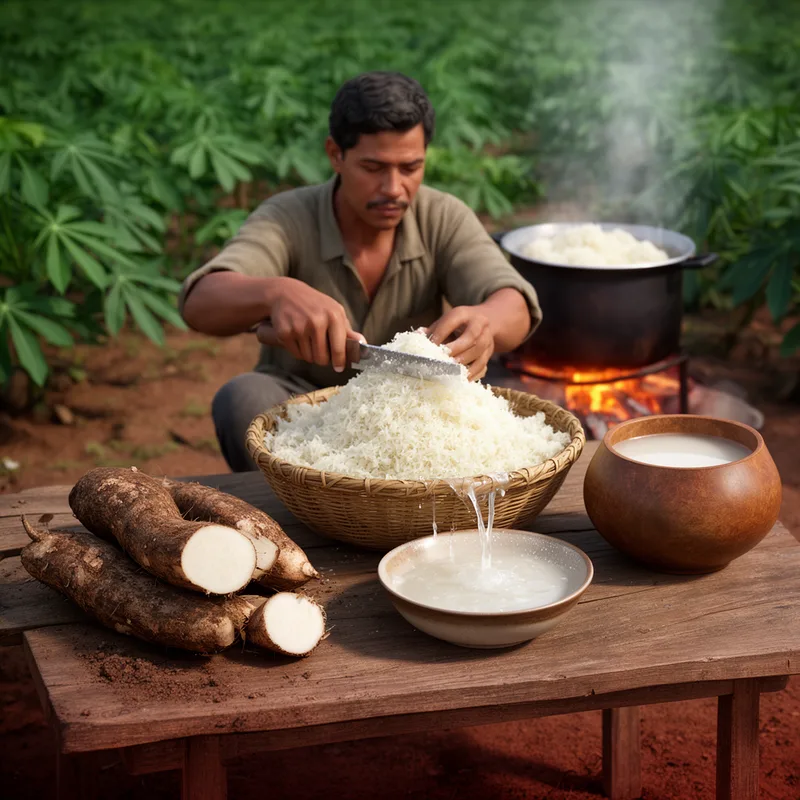
bitter cassava
- noun
- Indian
- Bitter cassava must be processed carefully to remove toxins before it is safe to eat.
Examples
-
The bitter cassava is often used to make traditional dishes.
-
Farmers often prefer growing bitter cassava due to its higher pest resistance.
-
Traditional beverages like cassiri are prepared using bitter cassava roots.
-
Did you try the bitter cassava at the festival?
-
Bitter cassava is often processed into cassiri, a popular alcoholic beverage in some regions.
-
In many tropical countries, people rely on bitter cassava for making tapioca pudding.
-
Farmers grow bitter cassava because its roots are high in nutrients and can be stored for long periods.
Synonyms

 6
6.3
6
6.3

A tropical plant with large starchy roots used for food
 1
7.5
1
7.5
A tropical plant with thick starchy roots used for food


 1
7.5
1
7.5
A tropical plant with a large starchy root used for food and to make flour
A plant with thick edible roots used to make food and products like tapioca
A tropical plant with large starchy roots used for food and to make tapioca
A plant with long edible roots grown for its starch used to make tapioca

A tropical plant with long edible roots that people use to make tapioca and flour
Surface Forms
Morphology
This is a straightforward adjective + noun combination where the meaning 'a variety of cassava that is bitter' follows directly from 'bitter' (having an unpleasant sharp taste) + 'cassava' (the root plant). The dictionary's technical note about cyanogenic compounds and uses does not affect the basic compositional meaning, so a B1 learner who knows both words will understand the MWE.
Etymology
Bitter cassava is named for the very bitter taste of some cassava roots. Those roots contain natural poison, so people learned to peel, soak, and cook them to make them safe. That's why bitter cassava points to both the taste and the danger and is used to make 'cassiri' and 'tapioca'.