
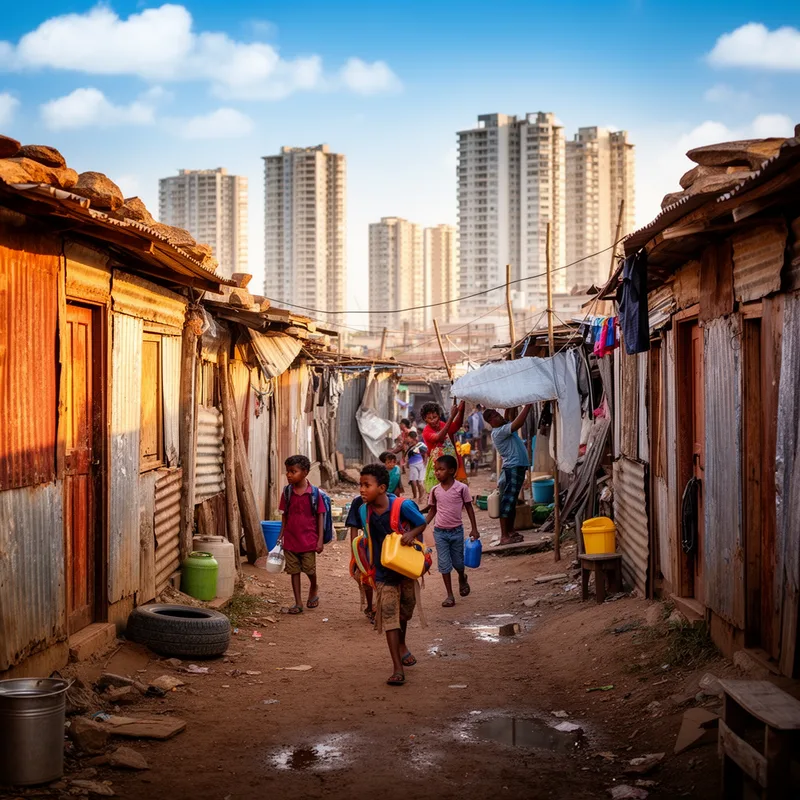
bidonville
- noun
- /ˈbɪdɒnˌviːl/
- A Nanterre psychology professor described it thus: "The university grounds are a site lost in the midst of cheap housing and immigrant ghettos (bidonville).
Examples
-
Many families live in bidonville areas where basic services are often lacking.
-
At least for the time being, neoliberalism has seen a massive transfer of wealth from the poor to the rich, and hence an increasing marginalization of the former, which is panoramically visible in the barrios, favelas, and bidonvilles of major cities in developing countries.
Academic text (2006) -
The documentary revealed the harsh living conditions in the city's bidonville neighborhoods.
-
After moving to the country, she was shocked to see the bidonville on the outskirts of the city.
Synonyms
 77
3.0
77
3.0

A poor part of a city with crowded, run-down houses and few services
 6
7.0
6
7.0
An area of a city where very poor people live in small rough houses
 2
2.7
2
2.7
A poor part of a city where many people live in small, crowded houses
How Run-Down

Surface Forms
Etymology
Bidonville comes from French: bidon means 'metal can' and ville means 'town', like the '-ville' in English place names. It gives the image of homes and shelters made from tin cans and scrap metal, so bidonville is used for a 'shantytown' on the edge of a city.