
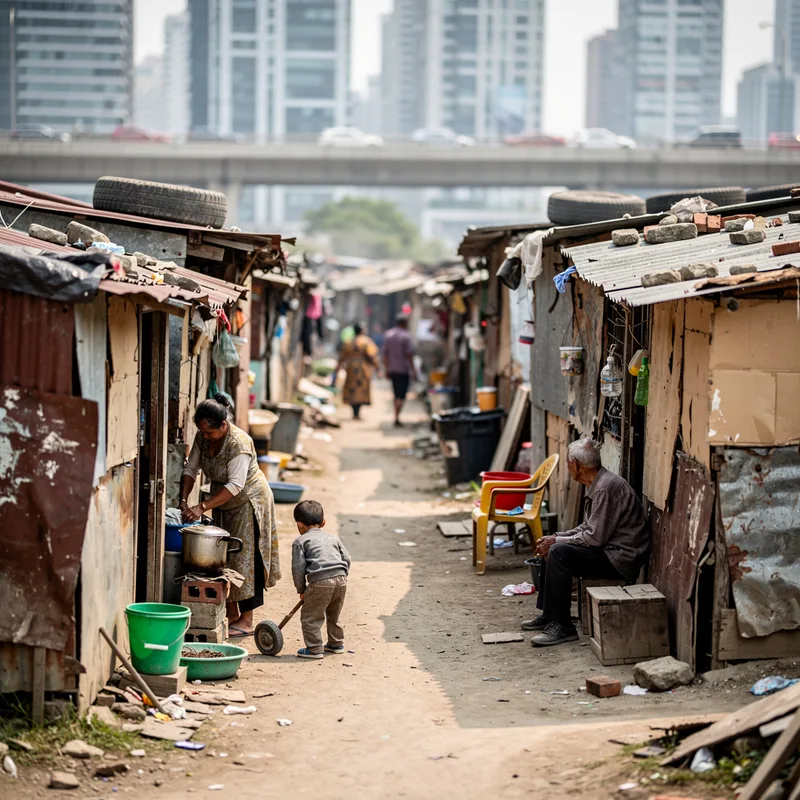
shantytown
 6
7.0
6
7.0

- noun
- /ˈʃæntiˌtaʊn/
- The poor and the unemployed live in overpopulated shantytowns, a condition characterized by need, hunger, and hopelessness.
- shantytown favela
- shantytown dwellers
- shantytown residents
Examples
-
In Peru, women from squatter families in Lima's shantytowns planted trees on barren ground.
Academic text (1990) -
The Kywezun Jetty is a fascinating, dilapidated shantytown on the banks of the Ayerwaddy.
Academic text (2005) -
Some of the men here in the shantytown worked to help build this concrete room for us.
Fiction book (1995) -
The history of Rocinha, currently the largest shantytown in Latin America, has yet to be written.
Academic text (1997) -
The streets are free; for example, children in a poor Caracas shantytown petition the local government for a place to play.
Academic text (1995) -
Studies of shantytown life outside Rio de Janeiro before 1970 are few.
Academic text (1997) -
Instead of attempting to infiltrate and then dominate an existing shantytown, the Shining Path organized a new settlement.
Academic text (1993) -
Huge shantytowns are already forming on the edges of Beijing, Shanghai, and other Chinese megacities.
Academic text (2011) -
Down on the water's edge was a more traditional crowded shantytown of dilapidated huts and uneven alleyways.
Academic text (2010) -
Kennedy described the living conditions in the shantytown as cramped and difficult, with many people residing in makeshift homes.
Synonyms
 80
5.6
80
5.6
A poor crowded part of a city where a minority group lives
 77
3.0
77
3.0
A poor part of a city with crowded, run-down houses and few services
 3
7.7
3
7.7
An area of a city where many homeless people live and buildings look run down
 2
2.7
2
2.7
A poor part of a city where many people live in small, crowded houses

A poor area on the edge of a city where people live in simple houses made from metal or wood
How Poor

Surface Forms
Morphology
Etymology
Shantytown is built from shanty ('a small, rough hut') and town. Shanty probably comes from the French chantier ('work camp' or 'building site'), so a shantytown is a part of a city made of many simple, temporary huts and shelters, which is why it means an area where very poor people live.