

biceps brachii
- noun
- /ˈbaɪsɛps ˈbreɪkiˌaɪ/
- Specialized
- During weightlifting, the strength of the biceps brachii allows me to perform exercises like bicep curls effectively.
- biceps brachii muscle
Examples
-
Barry et al. (5), working with the biceps brachii muscle, found a quadratic relationship between the acoustic signal's root mean squared (RMS) value and the weight applied to the hand.
Academic text (1996) -
Zwarts and Keidel (11) working also with the biceps brachii, showed that both integrated EMG and integrated VMG have a clear correlation with force.
Academic text (1996) -
The LE EMG activity indicated that the biceps brachii was active during the initial part of the pushing phase (pull motion) and during the latter part of the recovery phase.
Academic text (1992) -
He flexes his forearms (biceps brachii; C5-6).
Academic text (1995) -
Barry et al. (5) have noted that the RMS values of VMG and EMG signals increase with increasing load on the biceps brachii muscle.
Academic text (1996) -
The biceps brachii was also observed to be active during the pushing phase; however, since it was minimally recruited (approximately 30 percent of MVC), it did not significantly contribute to the motion and therefore was not greatly affected by a change in seat position.
Academic text (1992) -
The biceps brachii is crucial for lifting objects since it helps bend the elbow and turns the forearm so the palm faces upward.
-
To strengthen the biceps brachii, many athletes include arm curls in their workout routines to enhance muscle definition.
Synonyms

 26
3.2
26
3.2

A large muscle at the front of the upper arm with two parts that bends the elbow

A muscle in the upper arm that bends the elbow and turns the forearm so the palm faces up
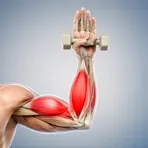
A muscle in the upper arm that bends the elbow and turns the forearm so the palm faces up
Surface Forms
Morphology
biceps + brachii
The term is morphologically compositional: 'biceps' denotes a two-headed muscle and 'brachii' specifies 'of the arm' (Latin genitive), so the phrase literally reads 'biceps of the arm' and directly identifies the upper-arm muscle. Anatomical Latin compounds are cross-linguistically regular, so a learner who knows both constituents can transparently infer the MWE's meaning, although the Latin form 'brachii' is technical and may be unfamiliar to typical B1 learners.
Etymology
Biceps brachii comes from Latin words: biceps means 'two-headed' and brachii means 'of the arm'. The name describes a muscle with two parts at the front of the upper arm that bends the elbow and turns the palm up, so it now means that upper-arm muscle.