
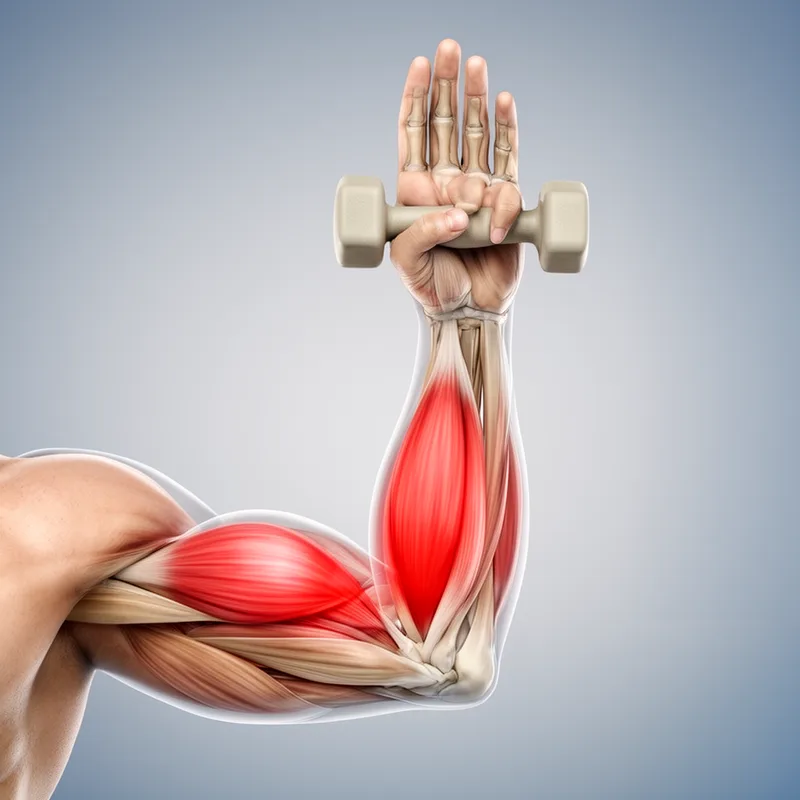
biceps humeri
- noun
- /ˈbaɪˌsɛps ˈhjuːməri/
- Specialized
 :
bíceps braquial
:
bíceps braquial
- The biceps humeri flexes the elbow, allowing the arm to bend.
Examples
-
The biceps humeri is often exercised through curls to build arm strength.
-
He strained his biceps humeri while exercising.
-
During the surgery, the doctor carefully examined the patient's biceps humeri for damage.
-
Strong biceps humeri are important for athletes who rely on arm movements.
-
The biceps humeri is essential for lifting objects.
-
Strong biceps humeri help you perform daily tasks like lifting groceries.
-
Weightlifters often train their biceps humeri to improve their overall strength.
Synonyms

A muscle in the upper arm that bends the elbow and turns the forearm so the palm faces up

A large arm muscle that bends the elbow and turns the palm up
Surface Forms
Morphology
The term is compositionally built from 'biceps' (a two‑headed upper‑arm muscle) and 'humerus' (the upper‑arm bone), so a learner who knows both constituents can infer it denotes the biceps associated with the humerus — i.e., a muscle of the upper arm. This anatomical genitive/compound pattern is cross‑linguistically common, making the basic referent immediately recoverable even if finer functional details (e.g., flexion vs. supination) are not fully specified.
Etymology
Biceps humeri comes from Latin and literally means 'two-headed muscle of the upper arm', with biceps meaning 'two heads' and humeri meaning 'of the upper arm'. So imagine two muscle 'heads' at the top of the arm that pull to bend the elbow and turn the forearm so the palm faces up, which is why this name refers to the muscle that does those actions.

