
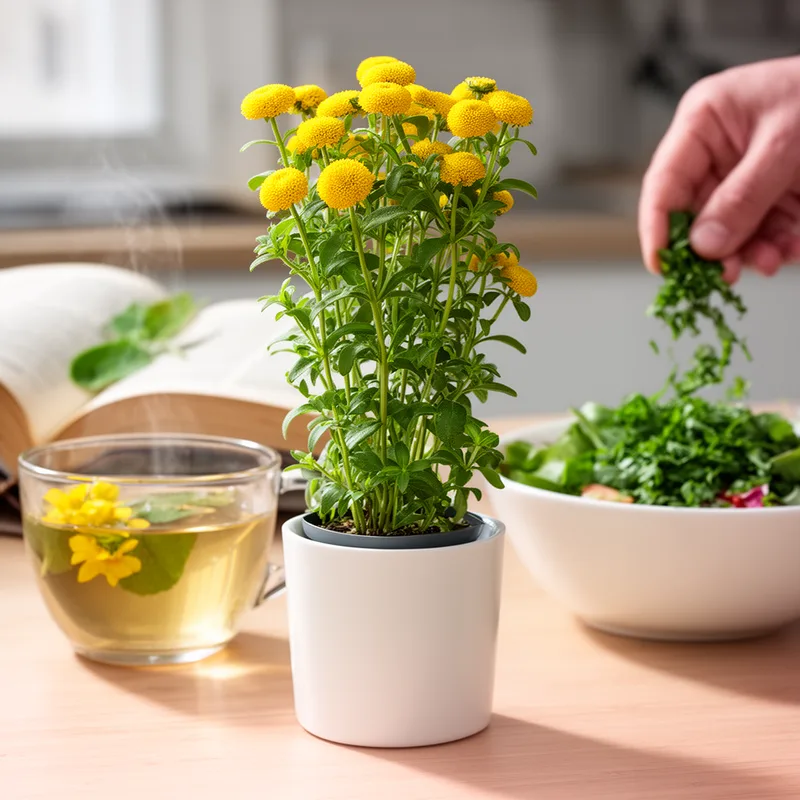
bible leaf
- noun
- UK
- She sprinkled chopped bible leaf into her salad for a unique, slightly bitter taste.
Examples
-
The herbal tea contained dried bible leaf along with other fragrant ingredients.
-
Historically, bible leaf was placed between the pages of books to keep them smelling fresh.
-
I added fresh bible leaf to my salad.
-
Have you ever tried using bible leaves in tea?
-
She sprinkled chopped bible leaf into her salad for a unique, slightly bitter taste.
-
The herbal tea contained dried bible leaf along with other fragrant ingredients.
-
Historically, bible leaf was placed between the pages of books to keep them smelling fresh.
Synonyms

A small herb with a mint smell used to add flavor to food or tea

A plant from Europe and Asia with small round yellow flowers used to flavor food, make tea, or scent potpourri
A leafy herb with a strong smell used in tea and to flavor food

A plant with a minty smell and yellow button flowers used in salads and tea

A leafy herb whose leaves people use to flavor food, with round yellow flowers and a strong smell

A plant with a strong smell whose leaves add flavor to food or tea
Surface Forms
Morphology
Although the constituents 'bible' and 'leaf' are familiar, their combination does not transparently yield the botanical sense given: a specific tansy‑scented herb. A B1 learner knowing 'bible' (a book) and 'leaf' (a page or a plant leaf) would more likely interpret 'bible leaf' as a page of the Bible or a literal leaf related to the Bible, not a lexicalized plant name. Because the meaning is a fixed common name for a plant and not compositionally predictable from the parts, it is opaque.
Etymology
Bible leaf got its name because people put a fragrant leaf inside their Bible as a 'bookmark' so the book would smell nice. So the name links the leaf and the book and helps you remember it is a small herb used in food and tea.

