
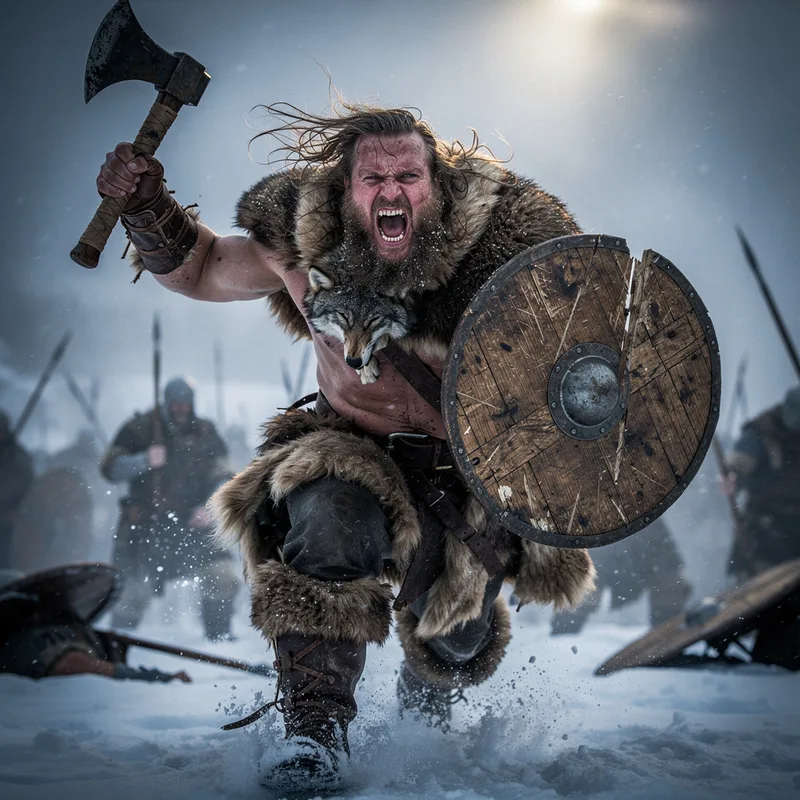
berserker
 8
9.9
8
9.9

- noun
- /bərˈzɜrkər/
- Literature
- I'm a Viking berserker.
- new berserkers
Examples
-
Cavell joined me, and with Arthur fighting like a berserker, the three of us swept the field.
Fiction book (1991) -
Now, assuming that one had become a berserker, how did they train?
-
With odds like that, only a fool or a berserker would fight if he had any alternatives.
Fiction book (1992) -
Mark your target, mark your target, he kept chanting to himself as he drew careful aim at an ax-wielding berserker.
Fiction book (1990) -
His eyes were clear, blue, and utterly vacant—a berserker.
Fiction book (1996) -
Brandon raged forward in a berserker frenzy, hacking at the tentacles with his axe, then stumbling away before they could enwrap him.
Fiction book (1992) -
As the battle began, he fought with the ferocity of a berserker, unleashing wild blows on his enemies.
-
The ancient Norse sagas describe a berserker who entered a trance-like rage before engaging in combat.
-
Legends tell of a fierce berserker whose uncontrollable rage terrified even the bravest warriors.
Synonyms
 7
9.9
7
9.9
A Norse warrior who fought in a wild, uncontrolled state before battle
 3
4.1
3
4.1
A person who fights bravely and with great force in battle
How Fierce

Surface Forms
Morphology
Etymology
Berserker comes from Old Norse roots ber- 'bear' and serkr 'shirt', so it gives the picture of a warrior who wore a bear skin. That's why a berserker was a fighter who acted like a wild, raging bear in battle.