
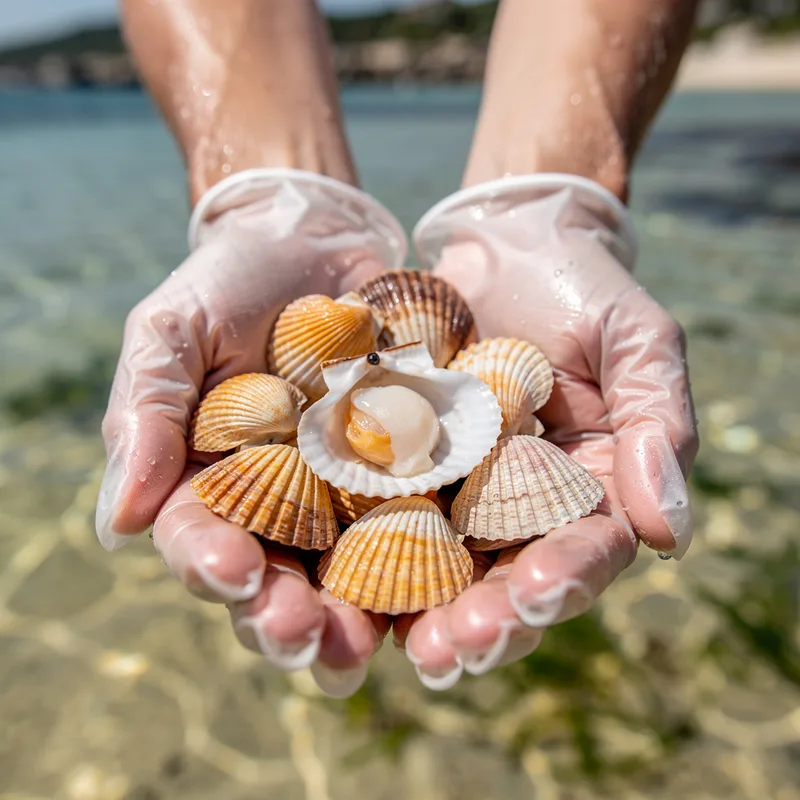
bay scallop
 1
3.7
1
3.7

- noun
- /beɪ ˈskæl.əp/
- US
- A similar or identical organism had been seen much earlier in bay scallops from U.S. waters (Ray and Chandler, 1955), and more recently by Karisson (1990).
- ounces of bay scallops
Examples
-
The light salt taste turned the bay scallop into a wonderful delicacy.
-
The bay scallop fishery, in particular, is heavily damaged by severe brown tides (Figure 3), with fishery yields reduced for years (Bricelj and Lonsdale 1997).
Academic text (2000) -
A bay scallop, I would say, actually.
-
Gimme, uh, gimme the bay scallops with Mercury poisoning.
-
Between 1983 and 1989, bay scallop landings fell by 88 percent.
Academic text (1993) -
Once the rays' abundance significantly increased, after about 1980, the abundance of one of their major food sources, the bay scallop, plummeted.
Academic text (2008) -
We've got bay scallops.
-
Ingersoll stated that fishermen gathered bay scallops by towing small, triangular dredges from rowboats or sailboats.
Academic text (1991) -
We had bay scallops and lump crabmeat a la Chesapeake as our main dish.
-
More petite bay scallops are prized for their sweet, delicate flesh and are noticeably pricier.
Synonyms
 2
3.4
2
3.4
A large sea animal with a shell that people eat for its tender meat

A small scallop that lives in shallow waters and mud flats on the east coast of North America

A sea animal with a fan-shaped shell eaten as food

A large scallop from the deep, cold Atlantic waters of North America valued for its meat
A large edible sea clam that lives in cold Atlantic waters
How Big

Surface Forms
Morphology
The meaning is directly compositional: 'bay' specifies the habitat/location and 'scallop' names the marine bivalve, so a learner who knows both words can infer it is a type of scallop from a bay. This location+noun compound is a common, cross-linguistic naming pattern for species and foods, making the phrase predictable to B1 learners.
Etymology
Bay scallop comes from where the animal lives and what it is: a small scallop found in shallow bay waters. Because these scallops live in warm, protected bays they have sweet, tender meat, so the name points to this particular 'small, edible shellfish' found along the Atlantic coast.