
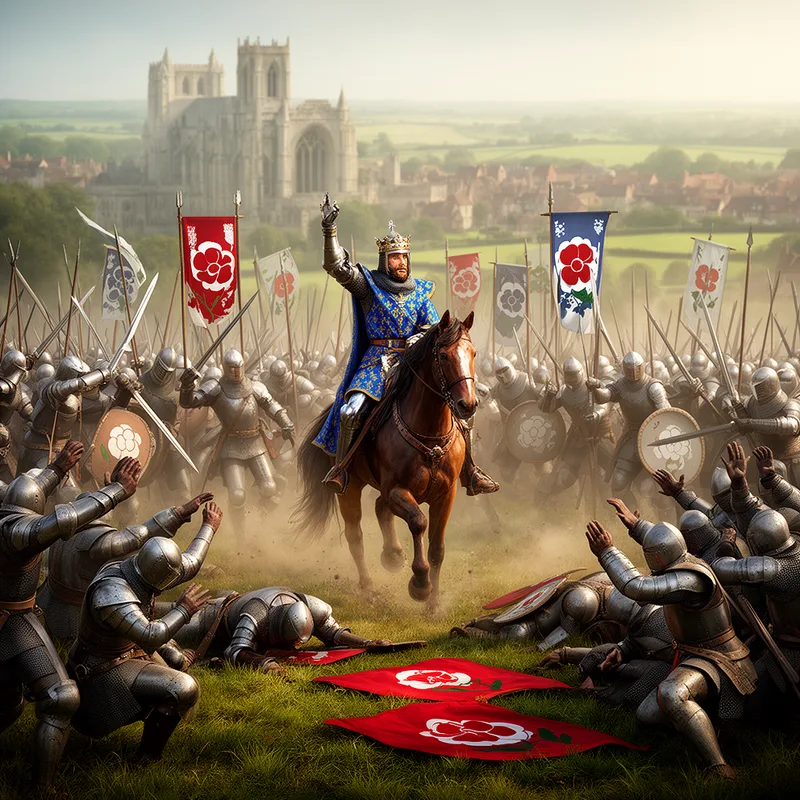
battle of Tewkesbury
- proper noun
- The battle of Tewkesbury was a decisive victory for Edward IV.
Examples
-
Historians often cite the battle of Tewkesbury as a turning point in the Wars of the Roses.
-
The battle of Tewkesbury marked the end of significant Lancastrian resistance to Edward IV.
-
During the battle of Tewkesbury, many leading Lancastrian nobles were killed or captured.
-
Did you know about the battle of Tewkesbury?
-
During the battle of Tewkesbury, many leading Lancastrian nobles were killed or captured.
-
Historians often cite the battle of Tewkesbury as a turning point in the Wars of the Roses.
-
The battle of Tewkesbury marked the end of significant Lancastrian resistance to Edward IV.
Surface Forms
Morphology
battle + of + Tewkesbury
The phrase is compositionally built: 'battle' + 'of' + a place name indicates a battle that took place at Tewkesbury, so a learner who knows the words will understand it refers to a battle at that location. The 'battle of X' pattern is a regular, cross-linguistic locative construction, though the specific historical details (date, participants, significance) are not recoverable from the constituents alone.
Etymology
Battle of Tewkesbury was the final big fight of the Wars of the Roses in 1471, fought near the town of Tewkesbury, where Edward IV defeated the Lancastrians. Because this one battle killed or captured many leading opponents, it is remembered as the moment that 'ended' major Lancastrian resistance.

