
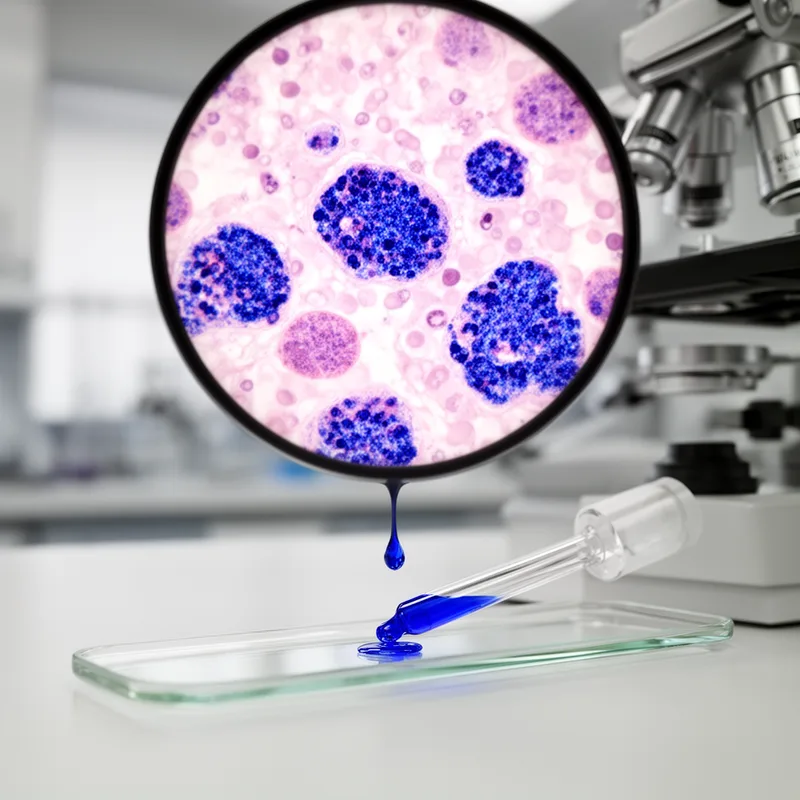
basophilic


 1
9.9
- adjective
- /ˌbeɪsəˈfɪlɪk/
- Specialized
- The pathologist noted that the basophilic staining of the cells helped in identifying the type of tissue under the microscope.
Examples
-
In the present study, calcifications appeared as large amorphous basophilic areas surrounded by a variable amount of fibrous tissue, frequently associated with inflammatory changes.
Academic text (2007) -
Many of the tumor nests contained multiple cystic spaces that were filled with basophilic mucoid material, which gave rise to a cribriform appearance.
Academic text (2006) -
A few tumor nests exhibit a cribriform pattern of cystic spaces filled with basophilic mucoid material (H&E; original magnification × 100).
Academic text (2006) -
The histological examination revealed numerous basophilic cells in the tissue samples, indicating a strong reaction to the alkaline dye.
-
During the analysis, we observed that the basophilic areas in the tissue indicated the presence of specific chemical groups.
How Stainable

Surface Forms
Morphology
basophilic = basophil (semi-transparent) = baso + phil + ic
Adding the productive adjective suffix '-ic' to the noun 'basophil' yields a predictable adjectival meaning 'relating to or characteristic of basophils or staining with basic dyes'.
Etymology
Basophilic comes from baso- meaning 'base', the opposite of 'acid', and -philic meaning 'loving'. So a basophilic cell 'loves' basic dyes and stains easily with them, which is why doctors call a cell 'basophilic' when it takes up those dyes.