
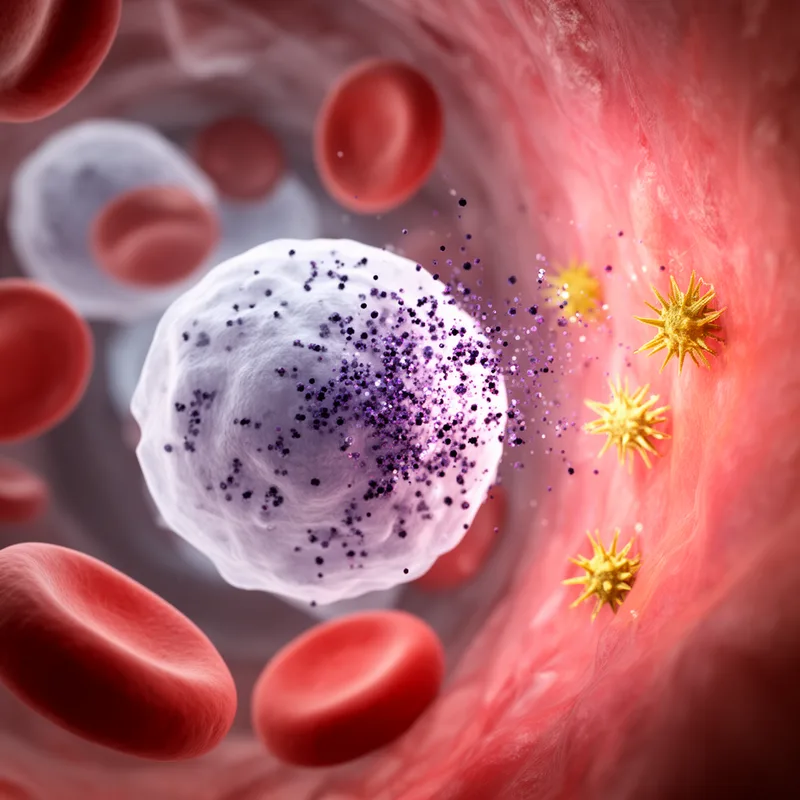
basophil


 1
8.9
- noun
- /ˈbeɪsəˌfɪl/
- Specialized
- In a blood sample, an increase in basophils can indicate an allergic reaction.
- basophil histamine release
- basophil release
- basophils and mast cells
Examples
-
The basophil plays a crucial role in the body's allergic response by releasing histamine.
-
So here we meet the Basophil, which is another white blood cell to add to our family.
-
Morphine and concanavalin A had only a small effect on basophil histamine release.
Academic text (1996) -
Spontaneous basophil histamine secretion was similar in patients and controls (Table 2).
Academic text (1996) -
Mast cells, eosinophils, and basophils are cells that defend US against parasites like worms.
-
The doctor explained that basophils are a type of white blood cell involved in fighting allergies.
Synonyms

A white blood cell with small parts that stain dark blue and help in allergies
Surface Forms
Morphology
basophil = baso + phil
The term is built from Greek combining forms ('baso-' = basic, '‑phil' = loving/affinity) that are not standalone English words and the meaning is technical, so an average B1 learner cannot reliably derive the sense from its parts.
Etymology
Basophil comes from the parts baso- and -phil, where baso- means 'base' as in the word basic and -phil means 'lover' or 'attracted to'. A helpful way to remember it is that basophils 'love' basic dyes and tiny parts inside them take up those stains, which is why the name describes this white blood cell that acts in allergies and inflammation.