
atomic number
 1
3.4
1
3.4

- noun
- /əˈtɑːmɪk ˈnʌmbər/
- Specialized
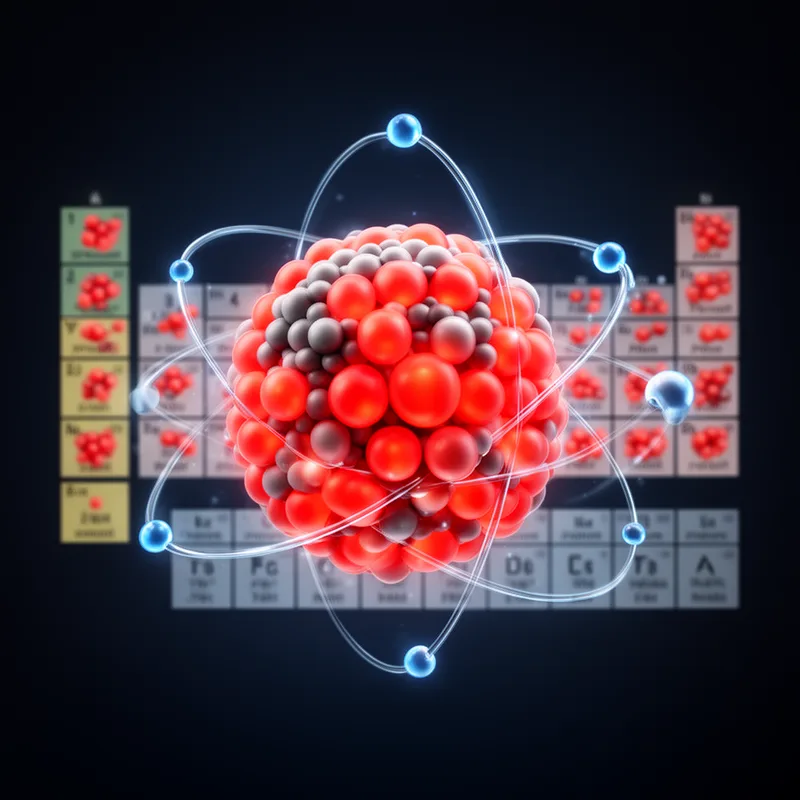
- The atomic number indicates the number of protons in an atom's nucleus, defining its element.
- atomic number Z
- high atomic number
Loading YouTube…
Watch on YouTubeHe's five years old, can recite the periodic table of elements with the corresponding atomic numbers at five years old.
- He's five years old, can recite the periodic table of elements with the corresponding atomic numbers at five years old.
- And in a simple nutshell, the the atomic number of the element told you what the what the elements the the number of protons.
Examples
-
The properties of new and artificially structured materials can be predicted and explained entirely by computations, using atomic numbers as the only input.
Academic text (1999) -
Photoconductive materials made of higher-atomic-number elements are especially desirable for their higher stopping power.
Academic text (2012) -
And its atomic number is 14!
-
Oh, Oh yeah, the Z is the atomic number, right?
-
It's a function of the atomic number of the specimen.
-
The atomic number remains the same after a capture event, but the atomic mass increases.
Academic text (2005) -
That's the atomic number for silver.
-
The atomic number of zinc is 30.
-
Gold does absolutely have an atomic number of 79.
Blog text (23) -
Because of the high effective atomic number needed to detect the 511 keV photons efficiently, bismuth germinate and other inorganic scintillators are now widely used.
Academic text (2004)
Surface Forms
Morphology
The compound is compositionally transparent in that 'atomic' (pertaining to atoms) plus 'number' (a numeral) lets a learner infer it denotes a number related to atoms. However, the precise technical sense — specifically the count of protons that identifies an element — requires domain knowledge of atomic structure and is not deducible by a typical B1 learner. The pattern is cross-linguistically common but still results in a partly technical meaning, so it is only partially transparent.
Etymology
Atomic number names the idea of a number for each atom: atomic points to the 'atom' and number is the count of protons in its centre, like an 'ID' for each 'element'. That's why the atomic number decides an element's place in the periodic table.