
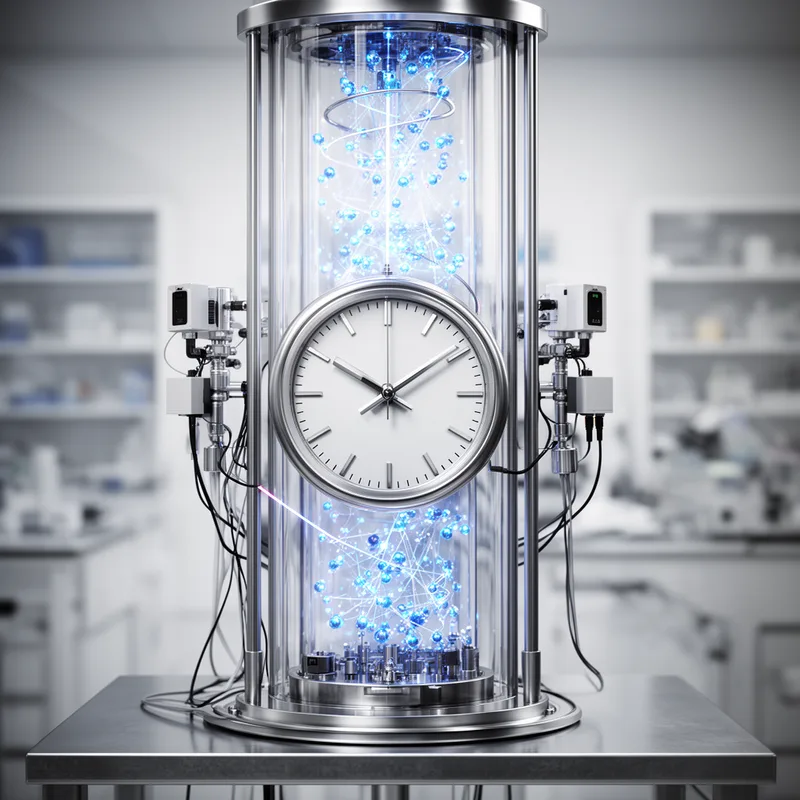
atomic clock
 5
4.3
5
4.3

- noun
- /əˈtɑːmɪk klɒk/
- Specialized
 :
reloj atómico
:
reloj atómico
- It happens to be the most accurate atomic clock in the world, and it's right here at the Institute of Technological Advancement and Research in downtown San Francisco.
- cesium atomic clock
- an accurate atomic clock
The clocks we use to keep the UK's time consists of a whole range of different atomic clocks.
- The clocks we use to keep the UK's time consists of a whole range of different atomic clocks.
- As for optical atomic clocks, any questions?
Examples
-
Scientists rely on the precision of the atomic clock for experiments in physics.
-
We have a whole suite of atomic clocks, cesium clocks, hydrogen mazers, and our cesium fountain.
-
So before the atomic clock, nobody knew what time it was.
-
This is a a modern atomic clock here on the right.
-
I need an atomic clock.
-
The way our atomic clocks measure time is through the motion of particles.
Blog text (31) -
Astronomers store the output of each antenna on a computer tape, along with time records from an atomic clock.
Academic text (1996) -
The GPS system depends on atomic clock synchronization.
Blog text (8) -
The atomic clock provides the most accurate timekeeping available today.
-
Each atomic clock is calibrated to ensure that it measures time with incredible accuracy.
Synonyms
 ∞
1.0
∞
1.0
A device that shows the time of day, usually on a dial or screen
 17
4.5
17
4.5
A thing like a clock or watch that shows the time
 5
8.6
5
8.6
A very accurate clock used to find position at sea or in science

 1
7.2
1
7.2
A very accurate clock that measures time using the vibrations of caesium atoms
How Precise
- UK
1
7.2

- Specialized
5
4.3
- Specialized
1
5.1
- Specialized
Surface Forms
Morphology
The noun-noun composition 'atomic' (relating to atoms) + 'clock' (timepiece) directly yields a clock that uses atomic properties to keep time; the intended meaning is a straightforward combination of the constituents. This compositional pattern is transparent and cross-linguistically common, so a B1 learner who knows both words should be able to infer the MWE's meaning.
Etymology
The noun atomic clock comes from the word atomic, meaning 'of atoms'. The device uses the tiny, steady 'ticks' or vibrations of atoms to keep time, so imagining atoms as tiny, perfect clocks helps explain why an atomic clock is very exact.