
antiparticle
 1
9.3

- noun
- /ˈæntiˌpɑrtɪkəl/
- Specialized
- I mean, the number of antiparticles and particles, it's conserved.
- particle-antiparticle
- antiparticle pair
Loading YouTube…
Watch on YouTubeIt's known that spontaneously from the vacuum, from a pure vacuum of space, particle antiparticle pairs can appear and disappear.
- It's known that spontaneously from the vacuum, from a pure vacuum of space, particle antiparticle pairs can appear and disappear.
- I mean, the number of antiparticles and particles, it's conserved.
Examples
-
Following his equations to their logical conclusion, Dirac also predicted that, for each elementary particle, there exists a corresponding antiparticle.
Academic text (2005) -
The universe around us exudes this very same ideal: for every particle, there is an antiparticle.
Academic text (2005) -
OK, maybe the world just started with more particles and antiparticles and end of story.
-
Without it, the universe would have no particles or antiparticles, just radiation.
Blog text (12) -
A red arrow might represent an electron coming into being with its antiparticle, a positron.
-
But all that Dirac taught us is that antiparticles exist.
-
If you look at the fundamental interactions of matter, particles and antiparticles have a great deal in common.
Blog text (33) -
WIMPs are presumed to be their own antiparticles and therefore capable of mutual annihilation.
Academic text (2012) -
In the earliest instants after the big bang, the temperature was so high that particles and antiparticles were liberally created in equal numbers from radiant energy.
Academic text (2004) -
Every particle has a corresponding antiparticle that possesses opposite charge.
Surface Forms
Morphology
Etymology
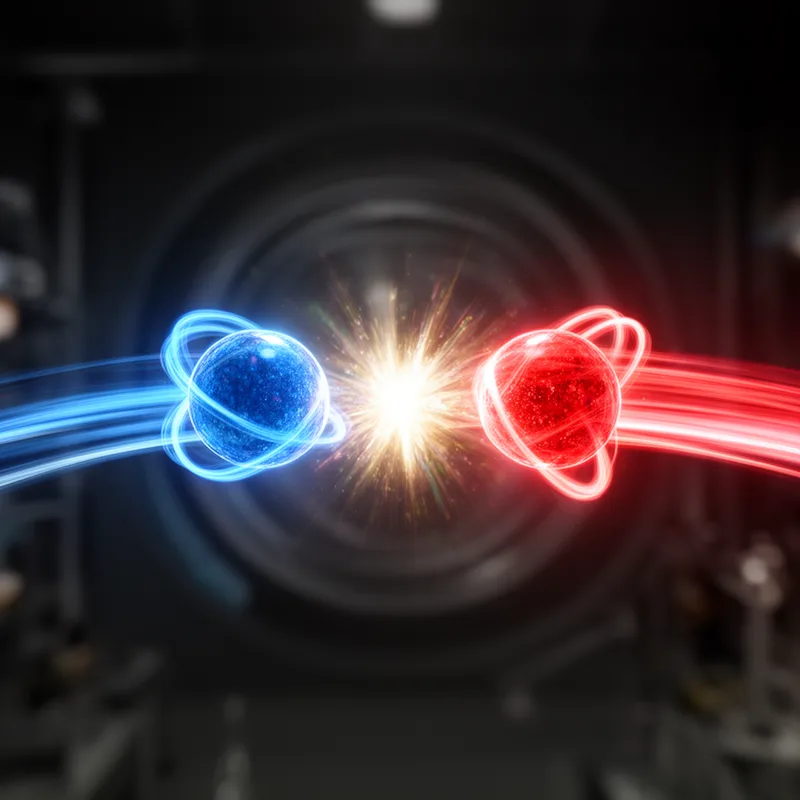
Antiparticle is made of anti- meaning 'against' or 'opposite' and particle meaning 'small piece', like in antibiotic or antifreeze where anti- means 'against'. So an antiparticle is a tiny counterpart that is the opposite of a particle — it has the same mass but an opposite charge, and when a particle and its antiparticle meet they cancel each other and release energy.