
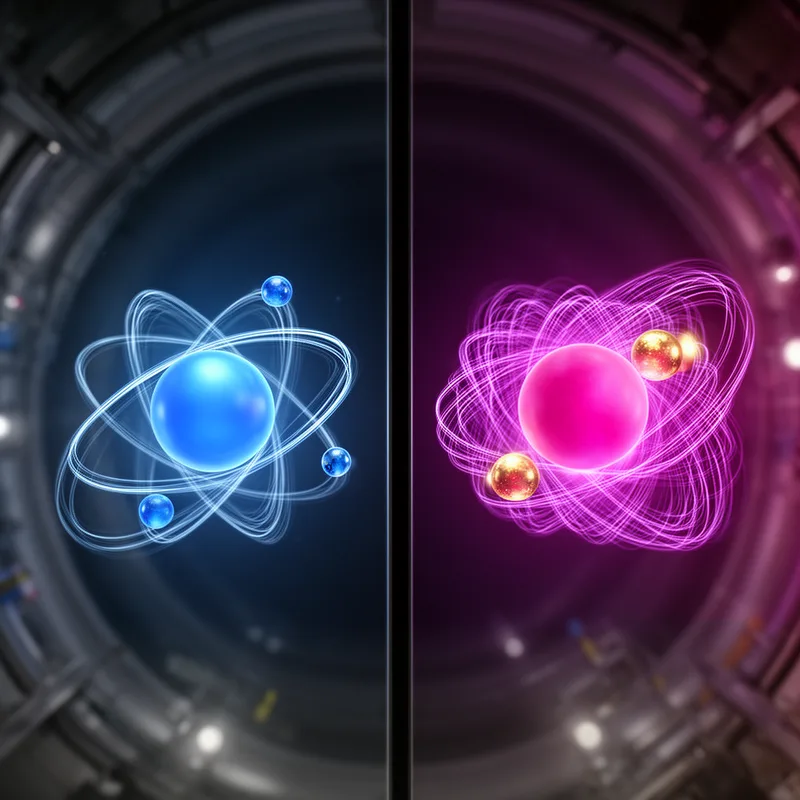
antihydrogen
 1
9.9

- noun
- /ˌæntiˈhaɪdrəʤən/
- Specialized
- To prove that they had formed antihydrogen, the ATHENA collaborators had to detect the nearly simultaneous annihilations of a p and an e+.
Examples
-
The convertible energy of 50,000 antihydrogen atoms is, according to Einstein's famous equation, about 1.5 x 10^-5 Joules.
Academic text (2005) -
The other option, which the ATRAP group has chosen, is to perform the measurements on antihydrogen held in a trap.
Academic text (2002) -
The experiment is so hard that forming antihydrogen is a big deal.
Academic text (2002) -
Occasionally, one of the newly produced positrons (e+) moved in the same direction and with the same speed as the "mother" p, which then picked it up to form antihydrogen.
Academic text (2002) -
Hangst commented that neutral traps for antihydrogen are not very deep and thus require the atoms to be as cold as a few degrees Kelvin.
Academic text (2002) -
He and his ATRAP collaborators are also attempting to produce and detect antihydrogen.
Academic text (2002) -
ATHENA, a second antihydrogen collaboration at CERN, has now accomplished that feat, detecting more than 100 atoms.
Academic text (2002) -
In 1999, the ATRAP team confined antiprotons and positrons in the same trap (n3) at temperatures as low as 4 K, but has not yet shown that antihydrogen is formed.
Academic text (2002) -
CERN's Antiproton Decelerator (AD) facility, created largely to support antihydrogen research (see PHYSICS TODAY, October 2000, page 22), supplies antiprotons traveling at about one-tenth the speed of light.
Academic text (2002) -
Researchers at CERN successfully created the first stable sample of antihydrogen in the lab.
Synonyms
 43
8.4
A kind of substance made of particles opposite to normal matter that release energy when they meet normal matter

 1
9.9
An atom made of particles that are the opposites of normal particles
Surface Forms
Morphology
Etymology
Antihydrogen is made of the prefix anti- meaning 'opposite' and hydrogen, a name that comes from parts meaning 'water' and 'to make', so it was called the 'water maker'. So antihydrogen is the 'opposite' of hydrogen — the antimatter form of hydrogen made of particles that are mirror copies of the normal ones.