

anisotropy
 1
9.9
1
9.9

- noun
- /ˌænɪˈsɒtrəpi/
- Specialized
- Engineers must account for anisotropy when designing structures, as materials can behave differently depending on their orientation.
- elastic anisotropy
- anisotropy in material
Loading YouTube…
Watch on YouTubeAnd that measure is called fractional anisotropy or FA.
- And that measure is called fractional anisotropy or FA.
- However, we wanted to test this by looking at the anisotropy in similarly distant astronomical sources.
Examples
-
We live in an exciting universe precisely because of the minuscule inhomogeneities and anisotropies that arose during its earliest moments.
Academic text (2005) -
Even more important than anisotropy may be the heterogeneity of properties within a fracture network.
Academic text (1997) -
And that measure is called fractional anisotropy or FA.
-
However, we wanted to test this by looking at the anisotropy in similarly distant astronomical sources.
-
Of course, the velocities of surface waves reflect the elastic anisotropy of the solid medium.
Academic text (1995) -
Anisotropic characteristics have been demonstrated in animal skin (20), though the degree of anisotropy depends on the location.
Academic text (1993) -
Fractures often have preferred orientations that impart an overall anisotropy, or enhanced direction of flow.
Academic text (1997) -
Figure 5 shows how scanning tunneling microscopy can readily demonstrate the existence of diffusional anisotropy.
Academic text (1993) -
The remarkable anisotropies in phonon propagation are an integral component of condensed matter physics at low temperatures.
Academic text (1995) -
Note that magneto-optic recording films possess vertical magnetic anisotropy; i.e., the magnetic domains are always oriented vertically.
Academic text (1996)
Antonyms
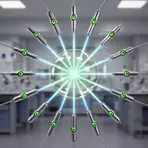
How Directional
- Specialized
1
9.9

- Specialized
1
9.9
Surface Forms
Morphology
Etymology
Anisotropy comes from Greek parts an- 'not', iso- 'equal' and -tropos 'direction' or 'turn'. So anisotropy means something is 'not equal' in different directions, for example a material that behaves one way along one axis and another way along a different axis.