
isotropy
 1
9.9
1
9.9

- noun
- /ˌaɪsəˈtrɑpi/
- Specialized
- Scientists study isotropy to understand how physical laws apply uniformly across different orientations in space.
- homogeneity and isotropy
Loading YouTube…
Watch on YouTubeAnd the choice of that special point for our coordinate system broke the isotropy.
- And the choice of that special point for our coordinate system broke the isotropy.
- The very, very high precision perfect isotropy would also mean perfect homogeneity for the universe.
- Yeah, if you it's a consequence of isotropy and and homogeneity.
Examples
-
The universe exhibits isotropy, making measurements of cosmic background radiation consistent from every angle.
-
We can assume homogeneity and isotropy when constructing our models, and although testable.
Blog text (7) -
Therefore, continued observations of isotropy will favor the cosmological models.
Academic text (1996) -
And so these functions don't depend on anything except the isotropy of space.
-
Group theory tells us that 60 is the largest number of points that can be arrayed with perfect isotropy on a sphere.
Academic text (1996) -
Homogeneity and isotropy may sound equivalent, but they're not.
Academic text (2005) -
The distant-galaxy or cosmological models seem to fit the key observations: isotropy and inhomogeneity.
Academic text (1996) -
Inflation, the early exponential expansion of the universe following the Big Bang, is invoked in cosmology to explain the large-scale homogeneity, isotropy, and near flatness of the cosmos.
Academic text (2012) -
For example, the temperature indicated by the cosmic background radiation is identical in all directions (that is, "isotropic"), excluding two known effects that produce deviations from isotropy: our galaxy's motion through the universe and early variations in density from which clusters of galaxies formed.
Academic text (2002) -
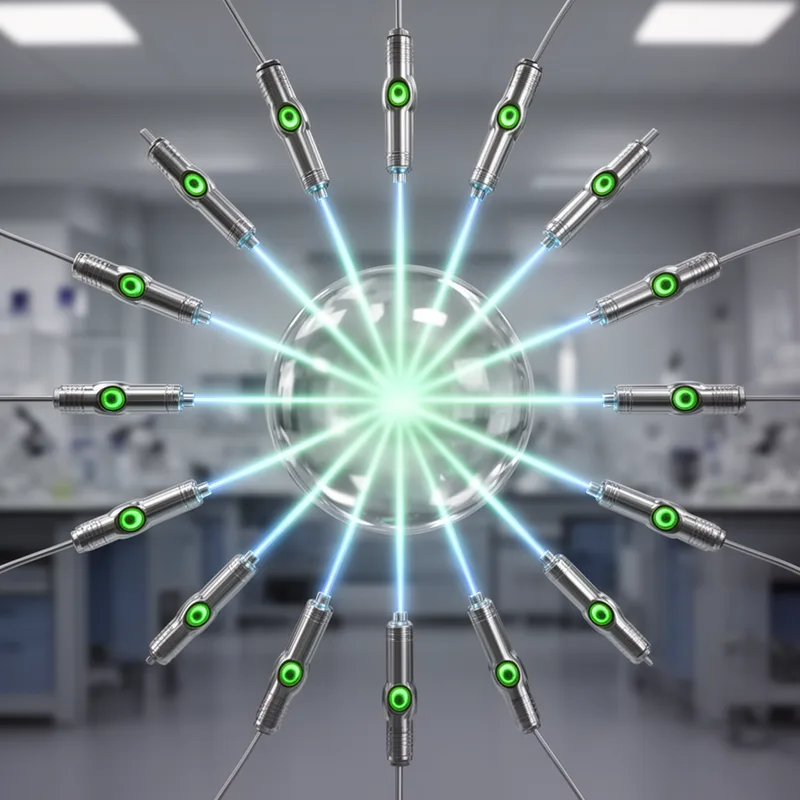
In physics, isotropy refers to the uniformity of a property, meaning it appears the same in all directions.
Synonyms
 18
4.6
18
4.6
The state of being the same in all parts
 11
4.9
11
4.9
The same features in every direction, like a perfect sphere
Antonyms

- Specialized
1
9.9
Different values when you measure something in different directions, for example in crystals
How Isotropic
- Specialized
1
9.9

- Specialized
18
4.6
2
7.9
- Specialized
1
9.9
Surface Forms
Morphology
isotropy = isotropic (semi-transparent) = iso + tropy + y
Formed from the adjective 'isotropic' with the noun-forming suffix '-y'; the relation is clear for technical users but relies on Greek combining elements that may be unfamiliar to general learners.
Etymology
Isotropy comes from the Greek parts iso- meaning 'equal' and -tropy from a word for 'turn' or 'direction'. So isotropy describes something that is the same in every direction, like a material that behaves the same no matter how you turn it.