
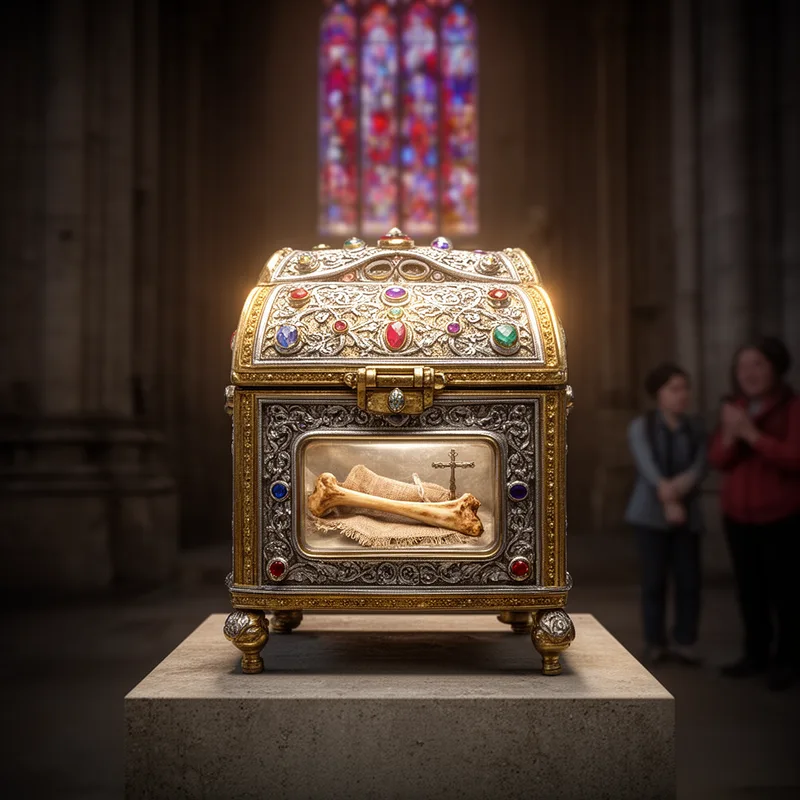
ancient reliquary
- noun
- /ˈeɪnʃənt ˈrɛlɪkwɛri/
- The museum displayed an ancient reliquary adorned with precious stones and intricate carvings.
Examples
-
Pilgrims traveled for miles to see the ancient reliquary believed to contain the saint's remains.
-
The museum displayed an ancient reliquary from the 12th century.
-
Historians studied the ancient reliquary to learn more about medieval religious practices.
-
Did you see the ancient reliquary in the cathedral?
-
Historians studied the ancient reliquary to learn more about medieval religious practices.
-
Pilgrims traveled for miles to see the ancient reliquary believed to contain the saint's remains.
-
The museum displayed an ancient reliquary adorned with precious stones and intricate carvings.
Synonyms

 37
9.9
37
9.9

A stone coffin often decorated with carved pictures and writing used in ancient burials
 5
9.9
5
9.9
A decorated container for keeping or showing holy objects like a saint's bone
How Old
 5
9.9
5
9.9
Surface Forms
Morphology
The meaning is directly compositional: 'ancient' (very old) modifies 'reliquary' (a container for relics), yielding 'an old container for sacred relics.' This adjective+noun structure is straightforward and cross-linguistically common, so a B1 learner who knows both constituents would readily infer the phrase's meaning.
Etymology
Ancient reliquary comes from the old practice of keeping a saint's bones or holy objects in a decorated box called a reliquary. So an ancient reliquary is an old box used to hold 'relics' or 'remains' and to show respect.